What Is AI? A Hong Kong Business Guide (2026)
 Anson Ng 3 min read
By 2026, almost every Hong Kong company has heard of "AI" — but for many, the idea still stops at "ChatGPT helps me write emails." This beginner guide explains, from a Hong Kong business perspective, what AI actually is, how it works, where it can save you money and time, and what it cannot do.
What is AI, in the simplest terms?
Artificial intelligence is a system that learns patterns from data and then uses those patterns to make decisions or predictions. Traditional software follows rules that humans write; AI discovers the rules itself from examples.
- Traditional program: "If temperature is above 40°C, raise the alarm."
- AI: After reviewing ten years of factory data, the system finds that a certain vibration pattern is usually followed by a breakdown within three days — so it warns you in advance.
That difference matters: AI is valuable exactly where you do not know the rule in advance, but you have enough history to learn from.
AI is not one single technology
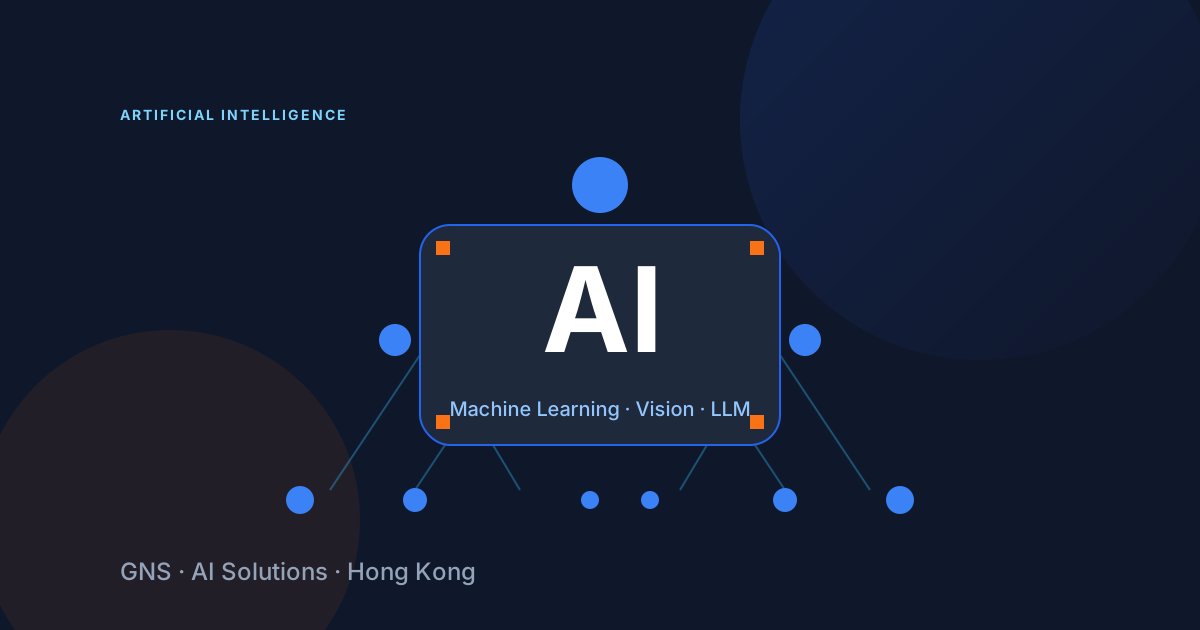
When Hong Kong vendors say "AI", they usually mean one of several different capabilities:
- Machine learning — predicting outcomes from data. Examples: forecasting allowable train running time, predicting which machine will fail next.
- Computer vision (deep learning on images/video) — quality inspection, depot monitoring, people counting, package measurement.
- Large language models (LLM) — understanding and generating text. Examples: customer-service chatbots, document summarisation, contract review.
- Reinforcement learning — learning the best policy by trial and error in an environment. GNS uses this to forecast safe train operation times from railway and weather data.
A real project often combines several: a camera (vision) feeds data into a model (machine learning), which triggers an alert in your existing system (integration).
Where Hong Kong businesses actually use AI
Predictive maintenance. Equipment telemetry is collected and analysed so failures are caught before they stop production. GNS applied this on the railway: a model forecasts allowable train running times using SACEM datalogger and HKO weather data, targeting 80–90% accuracy and cutting hardware-caused incidents by over 30%.
Quality inspection. Cameras check products at line speed — food quality control, surface defects, package measurement — far more consistently than human eyes.
Document and workflow automation. LLMs draft replies, summarise meeting notes, extract data from invoices and contracts, and route approvals. This is the fastest win for most SMEs.
Customer service. Chatbots handle common questions 24/7 in Cantonese, English and Mandarin, and hand over to humans only when needed.
Video analytics. Privacy-preserving analytics for depots, warehouses and public facilities — people counting, intrusion alerts, traffic monitoring. GNS's 3D monitoring solution records depth maps only, never optical images, so privacy is protected by design.
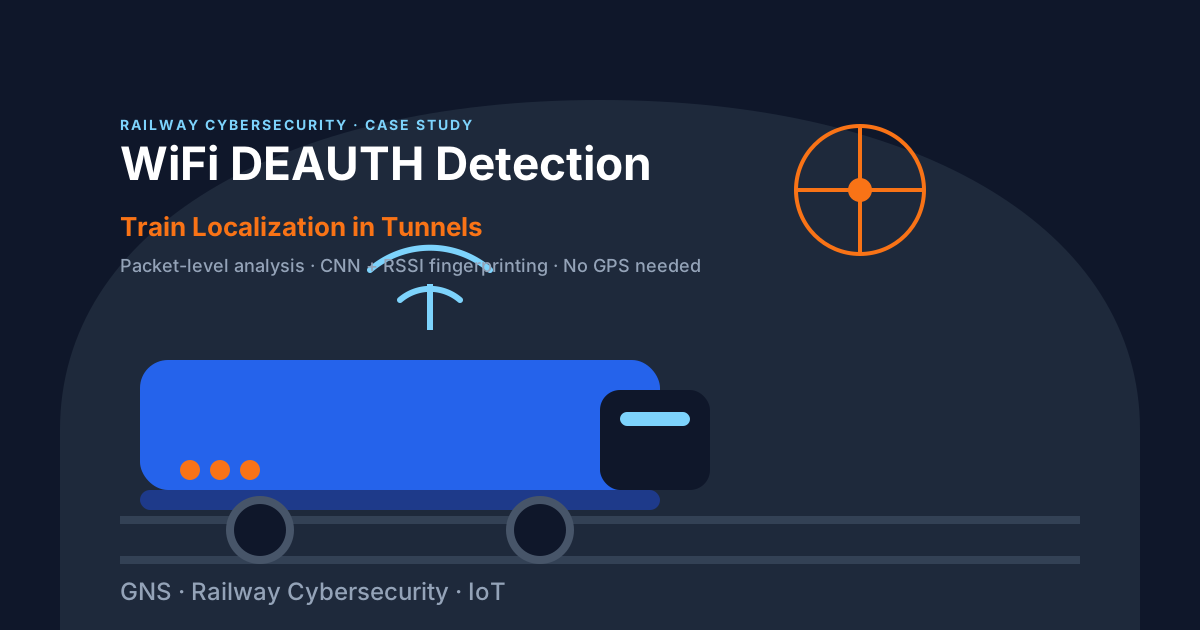
Railway and transport. Real-time analysis of over 100 million train data records a day, deauth-attack detection on train WiFi, and CNN-based train localisation inside tunnels where GPS does not work.
What AI cannot do (yet)
AI is not magic. A model is only as good as its data, and it cannot invent data that was never collected. It also does not replace the hard work of integration: the model needs clean feeds from your ERP, sensors or databases, and someone must operate and retrain it after go-live. That is why results depend far more on the delivery team than on the algorithm.
How a Hong Kong business should start
- Pick one operational problem with measurable value — not "use AI somewhere".
- Check what data you already have; most projects fail on data access, not algorithms.
- Run a small pilot (typically 3–6 months) before committing to a full build.
- Ask the vendor who supports and retrains the system after launch.
Want to see AI working in production — not just demos? Read our Hong Kong AI solution provider guide or talk to our engineers.
FAQ
What is the difference between AI and a normal software program?
A normal program follows rules a human wrote. AI learns rules from data, which lets it handle situations you could not pre-program — predicting failures, reading images and understanding language.
Does my company need AI?
If you have repetitive manual work, equipment that fails unexpectedly, or inspection that depends on human attention, there is probably an AI use case worth a pilot.
Is AI expensive?
Pilots can be scoped in months rather than years. Phased pricing lets you validate value before a full build, and annual maintenance after handover typically runs 10–20% of the build cost.
Can AI work with my legacy systems?
Yes, in most cases. GNS connects AI models to legacy ERP, railway and industrial systems through APIs and data bridging rather than forcing a rebuild.