Why GNS Built Its HQ Network on UniFi: An SI Perspective (2026)
GNS Engineering Team 4 min read
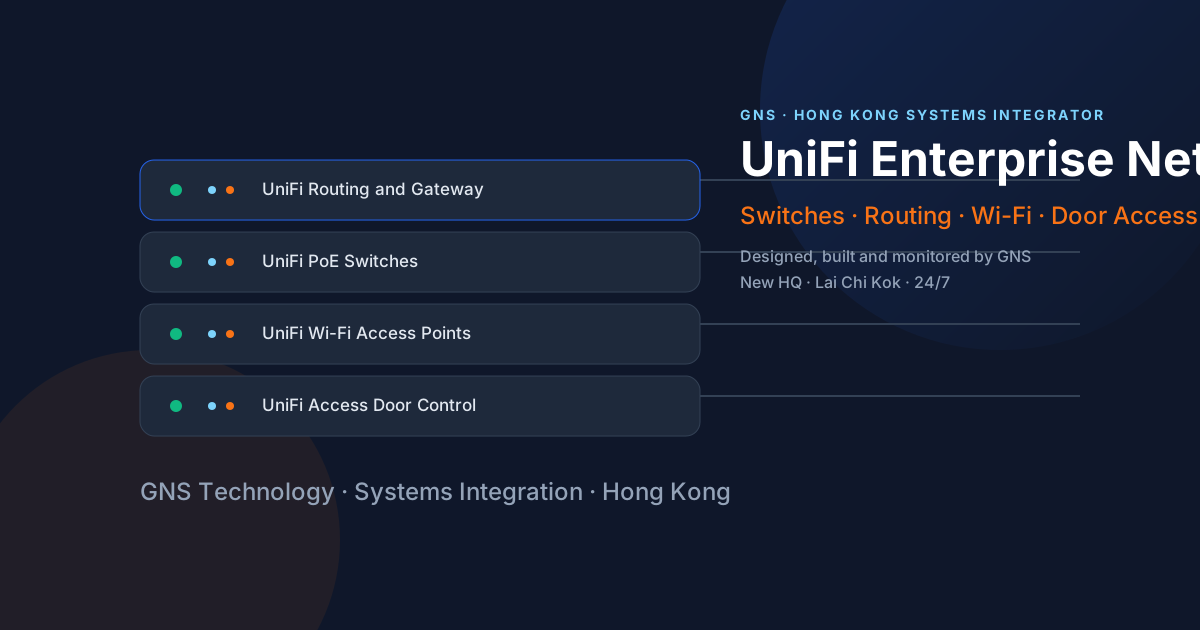
GNS recently moved into its new permanent headquarters in Lai Chi Kok. Instead of renting a managed network from a carrier, our own engineering team designed and built it end to end with UniFi switches, routing, Wi-Fi and door access — and we monitor it around the clock from the same office that supports government and railway projects. This article explains why we chose UniFi, what we use, and why we now recommend it to schools, government offices and SMEs.
The brief: our own network must prove our SI capability
As a Hong Kong systems integrator, we design, build and maintain networks for clients every day — from 69 light rail stations to government bureaux and factory floors. Our own headquarters is our showcase and our testing ground. The network had to:
- support a 24/7 engineering and support team working on government and railway projects;
- be manageable by a small team without an army of engineers;
- include door access and monitoring without a separate platform for each function;
- offer predictable costs — no surprise annual licence bills.
That brief naturally led us to a UniFi-based stack.
What we built
- Routing and gateway — UniFi gateway with VLAN segmentation, site-to-site VPN and policy-based firewall rules.
- Switches — PoE switches powering access points, cameras, door readers and office devices, with per-port VLANs separating guests, staff, IoT and management traffic.
- Wireless — ceiling access points covering offices, meeting rooms and the showroom, with separate SSIDs for staff, guests and IoT.
- Door access — UniFi Access readers and controllers at office entrances, with staff credentials, access schedules and entry logs.
- Monitoring — one dashboard for network health, device status, PoE usage, client traffic, door events and alerts.
"Soft-hard integration": why an SI makes the difference
Anyone can buy a switch and plug it in. The value of a systems integrator is turning boxes into a managed system:
- Design first — we map traffic, segments and physical cabling before installation, not after.
- Hardening — management VLANs isolated, default credentials changed, firmware updated, access audited.
- Integration — UniFi events are fed into our monitoring and alerting workflow, so problems reach engineers instead of sitting in a log.
- Documentation and handover — topology, IP plans, credentials and runbooks, the same documentation standard we deliver to government clients.
- Ongoing operation — firmware, backups and health checks are part of our 24/7 support model.
This is what we mean by 軟硬合體 (hardware plus software as one delivery): the network, the door system and the monitoring are designed and operated as a single system, not three separate purchases.
Cost-effectiveness versus traditional Cisco/FortiGate stacks
We still deploy enterprise brands such as Cisco and FortiGate where they genuinely belong — large data-centre cores, carrier-grade links and critical infrastructure that demand maximum scale, support and compliance. But for offices, schools and branch sites, our experience is consistent:
- Lower hardware cost — UniFi equipment is substantially more affordable than comparable enterprise-brand models.
- No mandatory annual licence — the UniFi controller and management app are free; traditional platforms often require annual support or subscriptions before full features are usable.
- Less maintenance overhead — one cloud-accessible dashboard covers network and door access, reducing the time staff spend on management.
- Faster deployment — a school or SME network can be designed, installed and commissioned in days rather than weeks.
To be clear, "cheaper" only matters if the equipment does the job. In the environments above, UniFi meets the requirement at a fraction of the total cost of ownership — and when a client genuinely needs carrier-grade redundancy or compliance-specific features, we say so and size accordingly. Independence is part of our SI role.
Who should consider this approach
- Schools and education — segmented networks for staff, students, IoT and CCTV, managed by one IT officer.
- Government offices and sub-offices — branch connectivity and door control with clear documentation and support, complementing core government infrastructure.
- SMEs and professional firms — enterprise-grade management at SME budgets, with remote monitoring included.
- Retail and franchise branches — standardised rollout across many sites with one dashboard.
The monitoring we rely on
The functions we use most are the everyday ones that keep an office honest: device and client status, PoE and switch health, traffic and throughput per SSID, VPN link state, door events and access exceptions, and alerts pushed to the team. Because the same office supports railway and government project work, our staff can quickly see whether an issue is in the office network, the door system or the internet uplink — and fix it before it affects anyone's work.
Summary
GNS chose UniFi for its own headquarters because it is cost-effective, easy to operate and powerful enough for real business use — and because we, as the integrator, add the design, hardening, integration and support that turn it into a dependable system. If your school, office or SME wants the same approach, talk to our engineers or read our network infrastructure solution page. For a broader shortlist framework across design, supply, installation, integration and maintenance, see how to choose a systems integrator (SI) in Hong Kong.
FAQ
Why does GNS use UniFi instead of Cisco or FortiGate?
For office, school and branch environments, UniFi delivers strong performance at a much lower total cost: the controller and mobile app are free, there is no mandatory annual licence fee, and one dashboard manages switches, access points, routing and door access. Traditional enterprise brands such as Cisco and FortiGate remain the right choice for large cores and critical infrastructure, where their higher cost buys the scale, support and compliance those environments require.
Is UniFi secure enough for business networks?
For typical business, school and government-office networks, UniFi supports VLAN segmentation, firewall rules, VPN, role-based access and regular firmware updates. GNS strengthens this with SI practices: hardening, segmentation, monitoring and alerting — the same discipline we apply to government and rail projects.
Can GNS help my school, office or SME build a UniFi network?
Yes. GNS is an independent systems integrator: we design, supply, install, configure and support UniFi networks, and we will recommend other vendors when the environment genuinely needs them. We provide quotes, documentation and 24/7 maintenance.
Does the UniFi controller really have no annual fee?
The UniFi Network controller/console software has no licence fee and no mandatory subscription for core management features. Hardware warranty and optional cloud services are separate. Compare this with enterprise brands that typically require annual support or subscriptions to unlock full functionality.