
T830L financial PTP timing explained: mixed protocols, L2/UDPv4 and multi-site design
GNS Engineering Team 6 min read
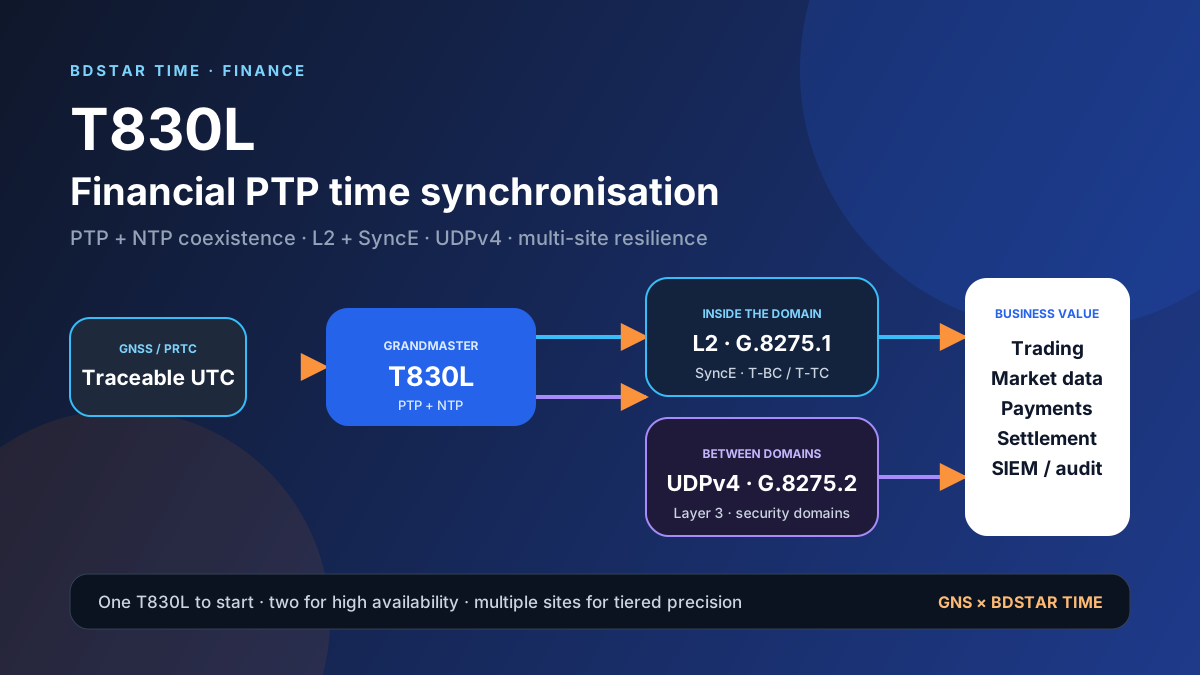
Financial trading cannot run on time that is merely “close enough”. Matching engines need defensible event ordering, market-data capture and replay need one timeline, orders and risk controls need consistent sequencing, and clearing and audit need to show where every timestamp came from. When NTP crosses Layer 3 and encounters congestion or asymmetric paths, occasional tail latency can make trading investigations, exception records and regulatory evidence difficult to reconstruct.
This guide is based on BDSTAR TIME's T830L financial-sector PTP pre-sales design. It explains three reference architectures: mixed-protocol coexistence, L2 precision inside a domain with UDPv4 between domains, and a multi-site hierarchical clock design.
Why ordinary NTP has a ceiling
NTP is widely supported and straightforward to deploy. It remains appropriate for many servers, switches and enterprise systems. Its limitation is that timestamps are normally generated in software, while network queuing, path length and asymmetry cause offset and jitter to move. Routine systems may not notice, but high-frequency matching, algorithmic trading, market-data replay and forensic evidence depend on controlling the tail rather than only the average.
A financial timing service needs a traceable path from GNSS or PRTC through the T-GM and the network's T-BC/T-TC devices to the client's T-TSC. Each hop must correct delay, expose health and define what happens when the source is lost.
What PTP adds
IEEE 1588 PTP uses hardware timestamps in network interfaces and switch chips to reduce host-stack jitter. Boundary clocks and transparent clocks correct residence time inside network equipment. SyncE adds frequency and phase synchronisation. Together they turn source-to-client error from an uncontrolled network effect into something that can be designed, measured and accepted.
The objective is not to replace every clock at once. A financial estate usually contains three terminal classes: L2-capable trading equipment, PTP-over-UDPv4 equipment spanning security domains, and legacy NTP-only systems. A practical design makes all three coexist.
What T830L contributes
T830L supports PTP and NTP, with L2 (G.8275.1) and UDPv4 (G.8275.2) PTP profiles. The vendor proposal covers SyncE, T-BC/T-TC, One-Step/Two-Step, 1PPS, ToD and 10MHz references, and an upgrade path from PRTC-A to PRTC-B with room for ePRTC evolution.
The deployment can also scale in stages: one unit to establish a local timing source, two units for high availability, then multiple sites and timing domains. This lets an institution secure the highest-risk trading path before rebuilding the entire network.
Three terminal classes, three timing paths
| Terminal capability | Recommended path | Why |
|---|---|---|
| PTP with L2 | L2 (G.8275.1) + SyncE | Lowest jitter and best symmetry inside a controlled network |
| PTP without L2 | UDPv4 (G.8275.2) | Traverses Layer 3 and security domains |
| NTP only | NTP | Keeps payments, settlement, operations, logs and office systems running |
The selection rule is: use L2 where possible; use UDPv4 for PTP-capable equipment without L2; keep NTP for NTP-only equipment.
Architecture 1: mixed-protocol coexistence
T830L outputs PTP and NTP in parallel. Trading gateways, market-data systems and other L2-capable equipment use L2 directly. PTP equipment outside the controlled Layer 2 segment uses UDPv4. NTP-only payment, settlement, operations and logging systems continue on NTP. Domain numbers, priority and VLANs provide lightweight separation.
The main benefit is a low-disruption rollout. The institution can align the whole estate to a controlled source, establish monitoring and then tighten the trading core in phases. This is often the right first step for Hong Kong estates with several vendors and equipment generations.
Architecture 2: L2 precision inside a domain, UDPv4 between domains
The matching, market-data and core trading segment can use L2 (G.8275.1) with SyncE, T-BC at core/aggregation and T-TC at access. Use One-Step where supported and Two-Step where compatibility requires it.
Cross-site, Layer 3 and security-domain links use UDPv4 (G.8275.2). The design does not insist on one PTP mode everywhere: it pursues precision inside the domain and deliverability, routing and operability between domains. The vendor proposal targets sub-microsecond/hundreds-of-nanoseconds inside the domain and low microseconds between domains; the exact result must be confirmed through equipment, network and PoC testing.
Architecture 3: multi-site hierarchical timing
A multi-site environment can use several T830L servers, with one T-GM elected in each local domain. The local core uses L2 plus SyncE, inter-site distribution uses UDPv4, and domain numbers and priority coordinate sources, resilience and steady-state consistency.
The vendor proposal separates targets by business tier: nanosecond class for trading, microsecond class for logs and millisecond class for office systems. That is more cost-effective than applying the highest specification and cost to every endpoint.
L2 or UDPv4?
| Consideration | L2 (G.8275.1) | UDPv4 (G.8275.2) |
|---|---|---|
| Scope | Controlled campus, data centre or core trading domain | Layer 3, multi-site, security domains and heterogeneous networks |
| Jitter and symmetry | Usually better | More dependent on routing, firewalls and configuration |
| SyncE | Suitable | Depends on path and equipment support |
| Typical use | Matching, market data and trading core | Inter-site links, DR and mixed-vendor segments |
One-Step or Two-Step?
One-Step completes the exchange with fewer messages and often produces lower jitter, but requires hardware support. Two-Step is more compatible and remains common across enterprise equipment. A practical design can regenerate One-Step at a supported T-BC boundary while leaving the rest of the estate on Two-Step.
Financial value
- Matching and algorithmic trading: stronger event ordering and better investigation of anomalous trades.
- Market-data capture and replay: one timeline for reproducing exceptions and root causes.
- Orders and risk: less drift-driven misclassification, duplication and rollback.
- Payments, clearing and reconciliation: transaction, clearing, core-banking and reconciliation records can be compared directly.
- SIEM and incident response: firewall, server, application and identity logs can be ordered consistently.
- Audit and evidence: a traceable UTC path from the source to each client.
A practical Hong Kong PoC
- Inventory trading, market-data, payment, settlement, SIEM and infrastructure endpoints, including their PTP/NTP capability, network location and existing time source.
- Measure client offset, jitter, packet loss and path delay during normal and peak periods to establish a baseline.
- Design the L2/UDPv4 boundary, PTP domains, VLANs, firewall rules, T-BC/T-TC placement and One-Step/Two-Step combination.
- Test GNSS loss, primary/standby failover, network interruption, asymmetric paths, alarms, log traceability and mixed-vendor clients.
- Migrate secondary systems first, then the trading and market-data core, with a documented rollback plan and acceptance evidence.
Acceptance documentation should include the network diagram, hardware and software versions, PTP profiles, domains, VLANs, ports, timing-source settings, client inventory, offset tests, fault drills, alarm captures and rollback procedure.
How GNS supports the project
GNS acts as the local systems integrator for T830L selection, design, antenna and equipment installation, PTP/NTP configuration, switch coordination, client testing, fault drills, acceptance documentation and local after-sales support. Where switching, firewalls, VLANs or inter-site links need changes, the same engineering team can coordinate the interfaces.
For a trading, market-data, payment, clearing or multi-site timing project, review the BDSTAR TIME Hong Kong solution or contact GNS to discuss a timing audit and PoC.
This article is based on BDSTAR TIME's T830L financial-sector PTP proposal and GNS engineering review. Final features, accuracy, compatibility and acceptance requirements depend on the exact model, software, network and project testing. Last updated: 27 October 2026.
FAQ
Is NTP enough for a financial institution?
NTP remains suitable for many general servers and office systems, but software timestamps, asymmetric paths and network queuing make the offset variable. Matching, market-data replay, low-latency strategy and traceable audit normally require PTP or a mixed NTP/PTP design.
Can T830L provide both PTP and NTP?
The vendor proposal lists parallel PTP and NTP output. L2-capable endpoints use L2, PTP-capable endpoints without L2 use UDPv4, and existing NTP-only systems remain on NTP.
Should an enterprise choose L2 or UDPv4?
A controlled core trading domain normally starts with L2 (G.8275.1) and SyncE for lower jitter and better symmetry. Layer 3, security-domain, cross-site and heterogeneous links normally use UDPv4 (G.8275.2). The final choice must follow the network and PoC results.
Is One-Step always better than Two-Step?
One-Step uses fewer messages and can reduce jitter, but requires hardware support. Two-Step is more compatible and remains common. Use One-Step at a supported T-BC core and retain Two-Step elsewhere where needed.
How should multi-site timing be designed?
Deploy a local T-GM in each site, use L2 and SyncE inside the domain, use UDPv4 between sites, and coordinate sources through domain numbers, priority and monitoring. Trading, logs and office systems can use different accuracy tiers.
What does a GNS timing PoC measure?
It measures offset, jitter, packet loss and path delay across trading, market-data, payment, settlement and SIEM clients, then tests GNSS loss, failover, network interruption, asymmetric paths, alarms, log traceability and mixed-vendor clients.