
T600-BDL high-capacity NTP
Vendor data lists support for more than 2 million clients and over 23,000 NTP requests per second, suited to a unified enterprise or critical-infrastructure time source.
GNS × BDSTAR TIME · Hong Kong time synchronization
GNS Technology Limited works with BDSTAR TIME to deliver T600-BDL secure NTP, T800L high-performance PTP/NTP and T830L financial-sector PTP clock servers for Hong Kong finance, rail, hospitals, utilities, research institutions, universities and data-centre machine rooms, including model selection, reference architecture, installation, testing, acceptance and local support.
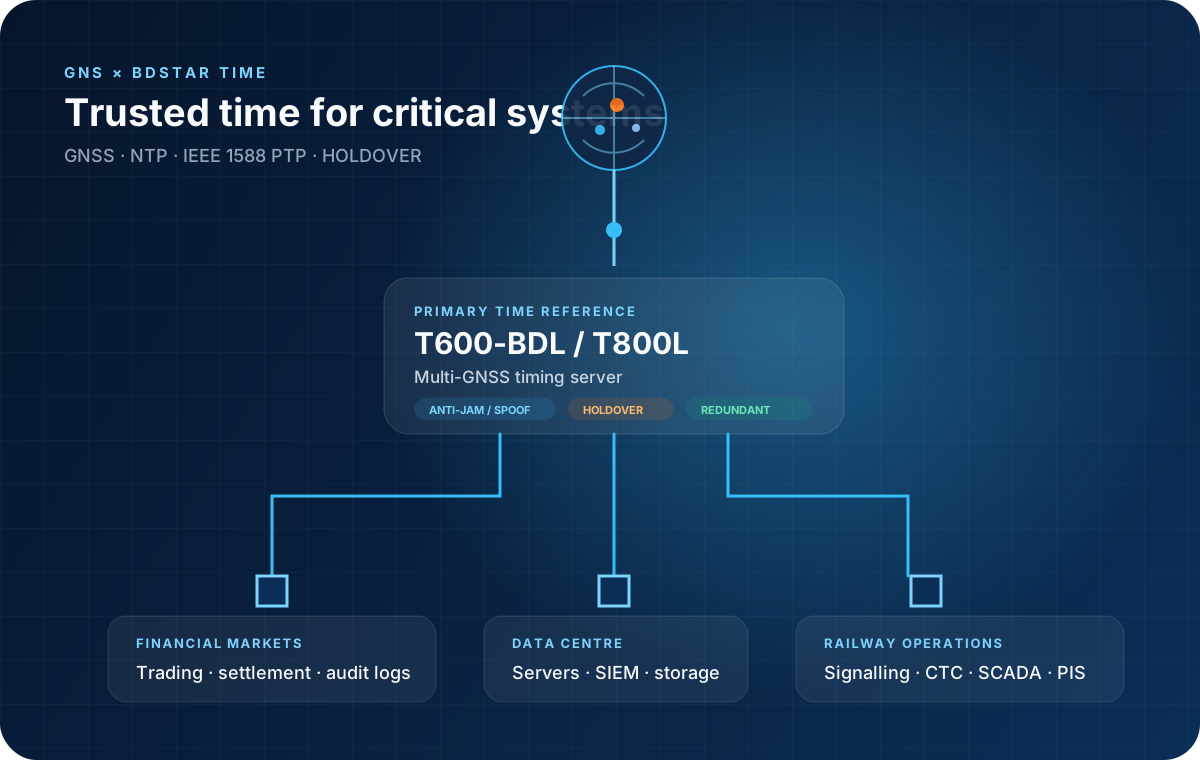
Beijing BDSTAR Technology Co., Ltd. (BDSTAR TIME), founded in 2015 and headquartered in Haidian, Beijing, is a national high-tech enterprise focused on BeiDou timing, navigation and frequency metrology. It develops, designs, manufactures and sells timing, frequency-metrology and satellite-navigation solutions, including NTP/PTP time servers, GNSS synchronised clocks, time and frequency references, fibre time-frequency transfer, atomic-clock modules and PNT systems. Its customers are located in more than ten countries.
The core team has long-standing R&D experience in time-frequency and navigation, covering high-precision timing, PNT integration, frequency measurement and control, fibre time-frequency transfer, holdover and interference mitigation. Vendor material lists deployments in deep-space exploration, the National Time Service Center caesium-clock programme, zero-interruption timing for the Beijing Winter Olympics and Belt and Road data-centre projects, alongside finance, government, rail, airport, broadcast, power, healthcare and cloud references.
When compared with European and American brands such as Meinberg, Safran, Microchip and Adtran, origin or a listed-company label should not replace technical due diligence. The decision should score protocol standards, nanosecond or microsecond accuracy, OCXO/rubidium holdover, jamming and spoofing protection, dual-server and power redundancy, management security, acceptance evidence and local support. BDSTAR TIME provides the corresponding product lines and standards; GNS adds Hong Kong selection, PoC, integration, installation, testing, acceptance and after-sales service to turn the vendor capability into an operating local solution.
Further reading: BDSTAR TIME company profile and R&D and technical capabilities.
Solution highlights
Vendor data lists support for more than 2 million clients and over 23,000 NTP requests per second, suited to a unified enterprise or critical-infrastructure time source.
Supports IEEE 1588 PTP and NTP, with PTP master-to-slave accuracy up to 10 ns for low-latency trading and time-sensitive networks.
T600-BDL offers an OCXO option with ≤10 µs holdover over 24 hours; T800L offers rubidium holdover at 200 ns over 24 hours.
BDS and multi-GNSS options are available; T800L receives GPS, Galileo, GLONASS, BDS and SBAS.
GNSS anomaly detection, multi-source comparison, loss-of-lock policy and alarms reduce the risk of interference or false signals.
Dual-server standby, heartbeat monitoring, bonding, redundant power and dry-contact alarms can be designed into the project.
NTP gives servers, switches and endpoints a shared UTC reference. PTP (IEEE 1588) further addresses network delay and oscillator behaviour to deliver higher precision for trading, control and telecom systems. Public internet NTP is convenient, but it cannot provide the same control over accuracy, availability, audit responsibility or fault handling. When trades, signalling, CCTV and SCADA events must be correlated, a time error becomes an operational and evidential risk.
Financial institutions need a consistent time base for matching, payments, settlement, market data, SIEM and regulatory records. Railway operations need signalling, CTC dispatch, communications, PIS, SCADA, CCTV and cybersecurity logs on the same timeline to support train operations, incident reconstruction and cross-region coordination.
GNS designs an independent time service around local GNSS clocks, a controlled network, holdover units and dual-server resilience, and includes NTP/PTP configuration, management, monitoring and acceptance in the project.
Financial-sector solution
A dedicated time-synchronisation design for trading, market data, payments, settlement, SIEM, dual data centres and regulatory audit, using PTP, NTP or a hybrid architecture according to each system's precision and availability requirements.
Provide consistent time to trading cores, order gateways, algorithmic trading and market-data servers, reducing disputes over event sequence and chronological reconstruction.
Align payment, clearing, core-banking, card-centre and reconciliation systems for transaction tracing, exception handling and regulatory records.
T830L supports PTP with L2, UDPv4, SyncE, boundary-clock and transparent-clock design options, suitable for trading networks that require lower jitter and a traceable timing chain.
Use PTP for trading and low-latency networks while payments, settlement, enterprise systems and monitoring logs continue with NTP. T830L can output both protocols, reducing the complexity of separate timing sources.
Synchronise firewall, server, application, identity and trading-platform logs to improve incident investigation, correlation and compliance evidence.
Use dual-server standby, cross-site resilience, independent GNSS sources and central monitoring for primary, standby or multi-site timing.
Align video, access-control, telephony and operations systems so event records share a reliable sequence.
Measure real client offset across trading, market data, settlement and SIEM, then test GNSS loss, primary/standby failover, PTP domains and NTP capacity as documented acceptance criteria.
The following content is based on BDSTAR TIME's T830L financial-sector PTP pre-sales proposal. Its core principle is PTP first with NTP coexistence: hardware that supports L2 uses L2; PTP-capable hardware without L2 uses UDPv4 (G.8275.2); existing NTP-only equipment remains on NTP. T830L can output PTP and NTP in parallel and can provide 1PPS, ToD and 10MHz physical references where required.
T830L outputs PTP and NTP in parallel. L2-capable clients use L2 directly to reduce jitter; PTP-capable clients without L2 use UDPv4 (G.8275.2) across Layer 3 and security domains; existing NTP-only devices remain on NTP. Domain numbers, priority and VLAN provide lightweight separation, allowing a low-disruption rollout that first aligns the estate and then tightens the critical paths.
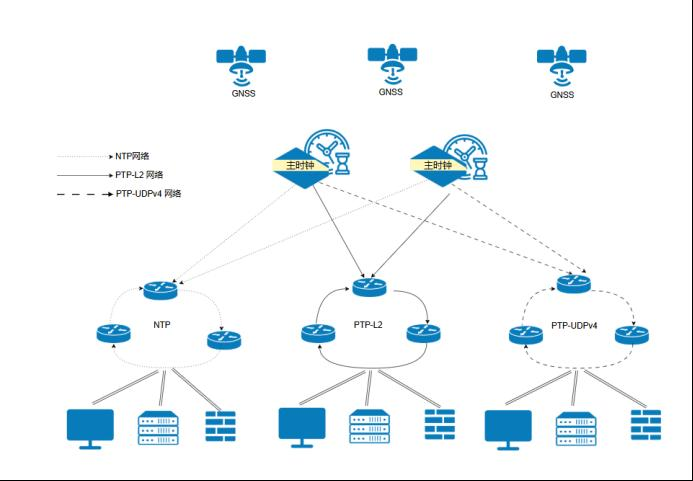
Vendor Option 1: PTP L2, PTP UDPv4 and NTP coexistence. Select the image to open the original size.
The matching and market-data core uses L2 (G.8275.1 + SyncE), with T-BC at core/aggregation and T-TC at access. Use One-Step where supported and Two-Step otherwise. Cross-site, Layer-3 or heterogeneous segments use UDPv4 (G.8275.2), targeting sub-microsecond/hundreds-of-nanoseconds within the domain and low microseconds between domains. The two options can progress together: first make the estate aligned, then tighten the critical path.
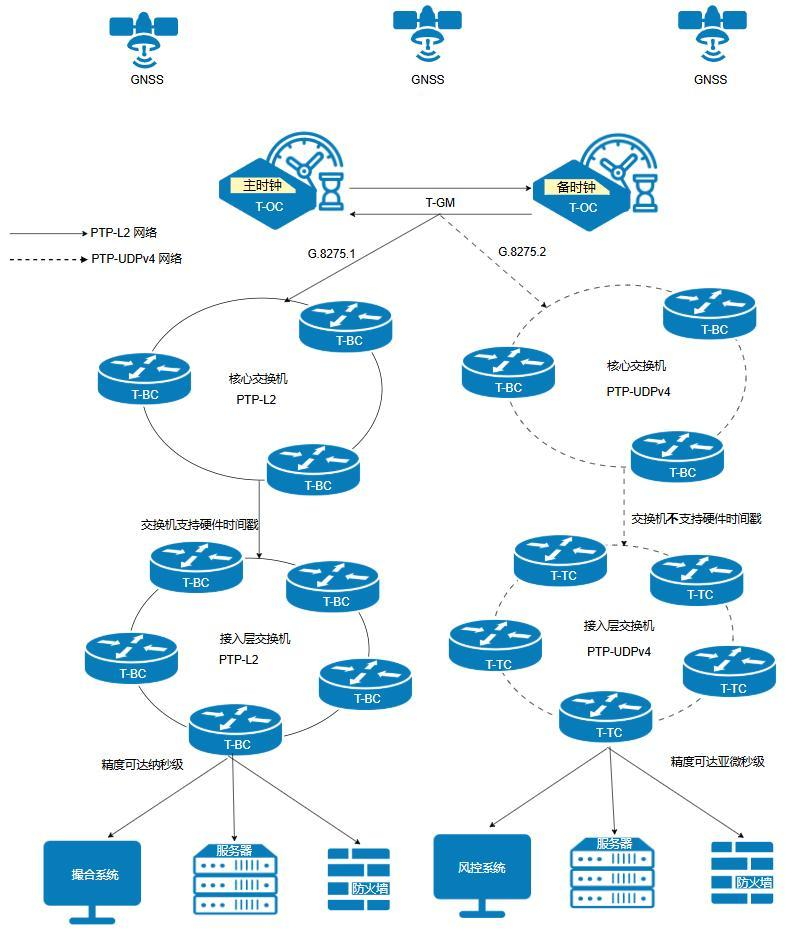
Vendor Option 2: L2 precision within the domain and flexible UDPv4 interconnection between domains. Select the image to open the original size.
A multi-site environment can deploy several T830L servers, with one T-GM elected in each local domain. The local core uses L2 (G.8275.1 + SyncE), while inter-site distribution uses UDPv4. Domain numbers and priority orchestrate multiple sources, resilience and steady-state consistency. The vendor proposal targets nanosecond-class timing for trading, microsecond-class for logs and millisecond-class for office systems, allowing different business tiers to receive the appropriate precision without applying the same cost to every endpoint.
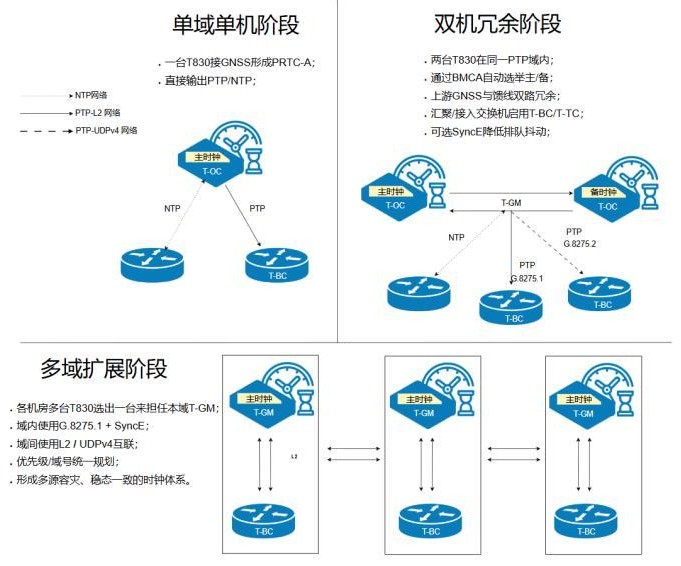
Vendor Option 3: multi-site T-GM, T-BC/T-TC, L2 and UDPv4 hierarchy. Select the image to open the original size.
Financial projects should begin with a timing audit and PoC: measure the current offset of trading, market-data, payment, settlement and log clients, then define the L2/UDPv4 boundary, PTP domains, server count, SyncE and One-Step/Two-Step mix. GNS then delivers installation, configuration, testing, acceptance documentation and local after-sales support.
Read the detailed guide: T830L financial PTP timing explained.
Rail and public transport
The vendor railway reference design deploys time servers in the general dispatch centre or station control room and distributes NTP/SNTP to operational systems.
Provide consistent time for signalling, interlocking and related control systems to support event sequencing and fault analysis.
Align dispatch platforms, timetables and operational records across regions and service groups.
Place power, environmental and equipment alarms on the same timeline for faster fault localisation.
Keep service information, announcements and broadcast systems aligned to the same time reference.
Synchronise video, network-device and security logs for incident reconstruction and audit.
Maintain one standard time across stations, control rooms and data centres in multi-site railway programmes.
More critical industries
Each environment needs a controlled, traceable time reference; accuracy, protocols and deployment are designed around the endpoints, compliance requirements and network architecture.
Align electronic health records, PACS imaging, laboratory systems, access control, CCTV, wireless networks and operational platforms to support cross-system event reconstruction, audit and fault analysis.
Create one UTC timeline for SCADA, substations, protection and control, disturbance recording, dispatch systems and cybersecurity logs; assess PTP/NTP accuracy and interfaces against project requirements such as IEC 61850.
Use GNSS, OCXO/rubidium references, frequency standards and fibre time-frequency transfer to establish a traceable reference for experiments, measurement, calibration and long-running records.
Synchronise campus networks, research laboratories, HPC/data centres, CCTV, access control and teaching systems to support cross-department record correlation, cybersecurity and research-data traceability.
Provide a consistent time source for servers, storage, virtualisation, trading or application systems, backups and SIEM logs, with NTP/PTP, dual servers, dual power, GNSS antennas and monitoring designed as required.
Every environment needs signal integrity, availability, cybersecurity, monitoring and acceptance evidence; GNS incorporates these into selection, PoC, installation and handover documentation.
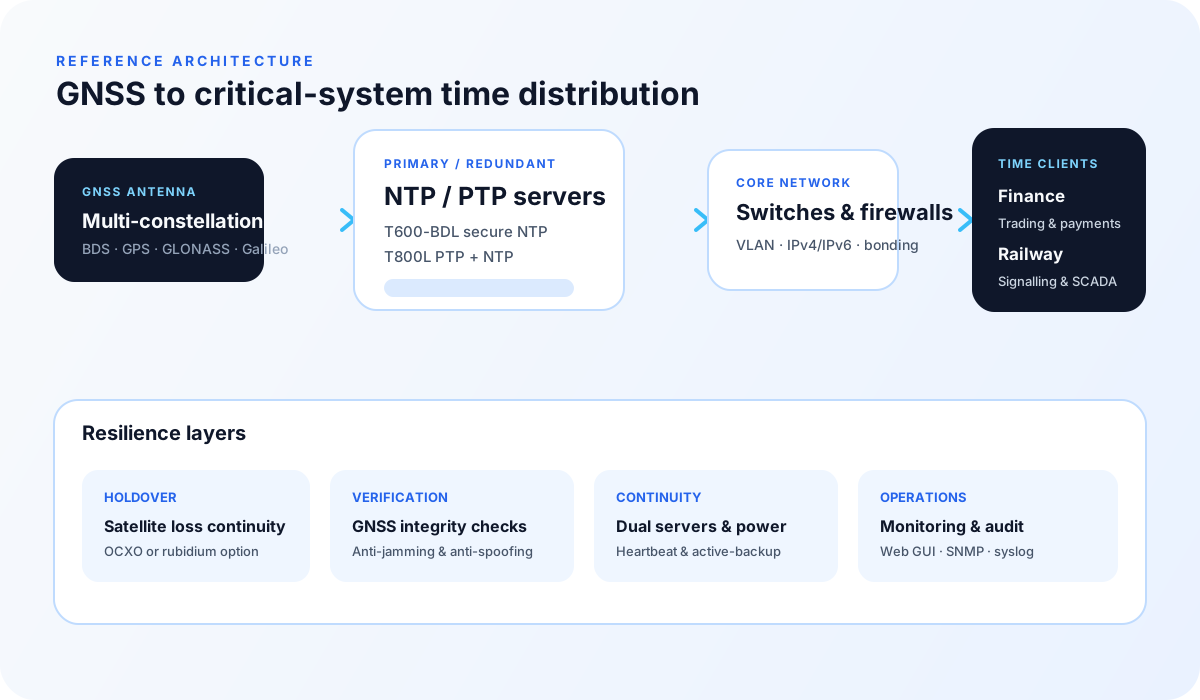
Reference architecture
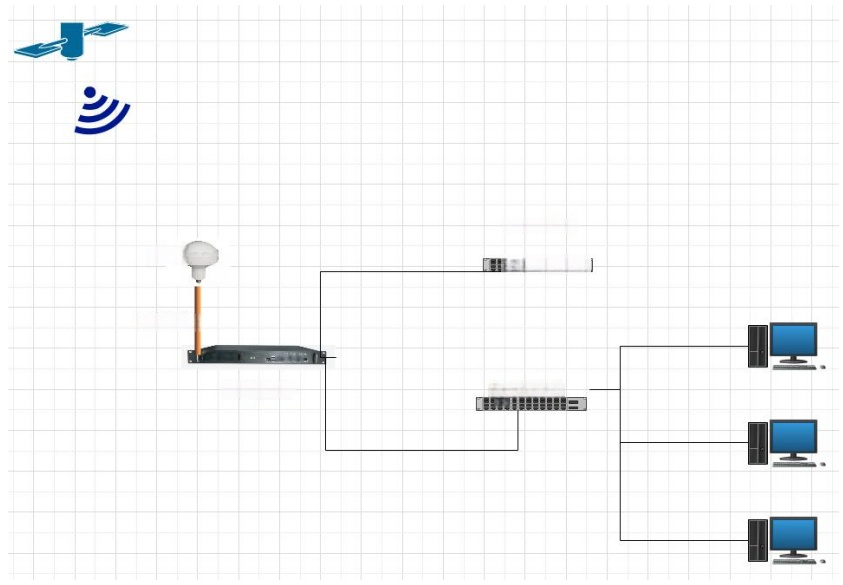
Vendor reference design
The vendor railway design uses GNSS as the standard time source and deploys T600-BDL in the general dispatch centre or station control room to provide NTP/SNTP time to core servers, industrial ring-network switches, dispatch platforms and intelligent applications.
The design can add a rubidium atomic clock or high-performance OCXO for continuity during loss of satellite lock or network connectivity. Multi-constellation GNSS can be configured for regional satellite availability.
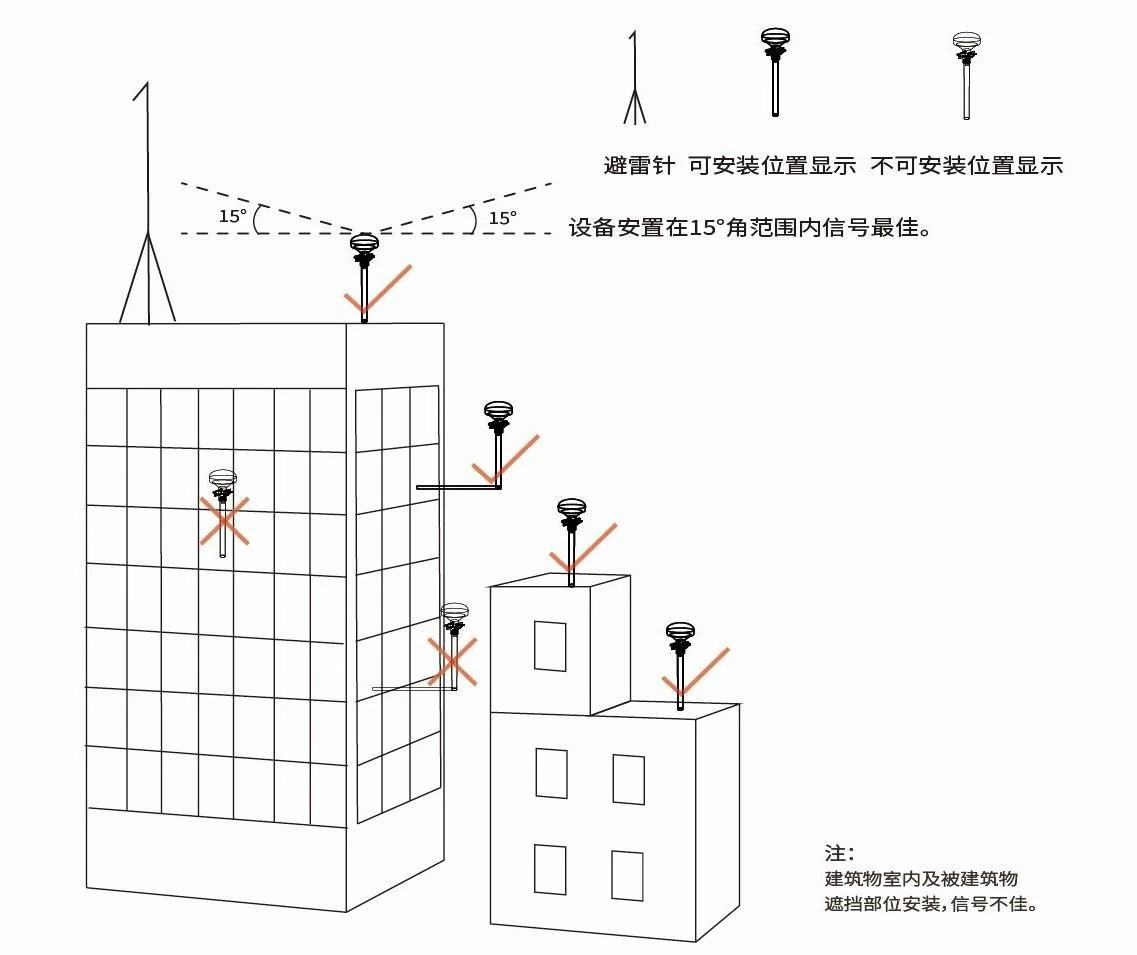
Antenna location, dual-server architecture, VLANs, IP addressing and client scope must be confirmed through site survey and detailed design.
Product portfolio
The following summarises the vendor material. Final features and accuracy depend on the exact model, options, network and site conditions.
For government, finance, power, rail and data centres; NTP/SNTP, multi-GNSS, BDS-only option, six 1GbE copper ports and two 1GbE optical ports, secure Web management, audit, SNMP, redundancy and dual-server standby.
For high-frequency trading and low-latency networks; IEEE 1588 PTP, NTP/SNTP, SyncE-related standards, multi-GNSS, jamming/spoofing protection, 10 ns master-to-slave accuracy and 256 PTP unicast clients, with boundary/transparent/ordinary clock, BMC, one-step/two-step, Layer 2/UDP and IPv4/IPv6 capabilities.
For financial trading and multi-site networks; supports L2 (G.8275.1) and UDPv4 (G.8275.2) PTP, SyncE, T-BC/T-TC, One-Step/Two-Step and parallel PTP/NTP output, with 1PPS, ToD and 10MHz references. The timing source can be upgraded from PRTC-A to PRTC-B where required, with an evolution path to ePRTC.
Central visibility of satellites, timing, servers, client offset, alarms and resources, with role-based access, audit logs, email, syslog, SNMP and bulk monitoring.
High-sensitivity GNSS antenna, specified feeder cable, mounting kit and surge arrester, followed by grounding, signal-quality and loss-of-lock alarm testing.
Hardware and installation
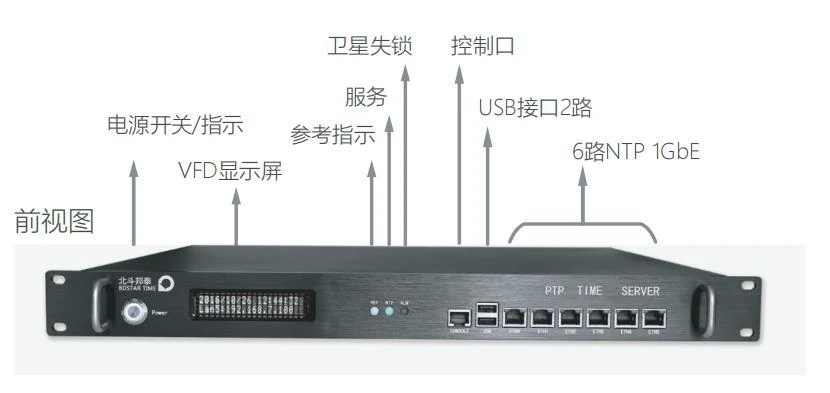
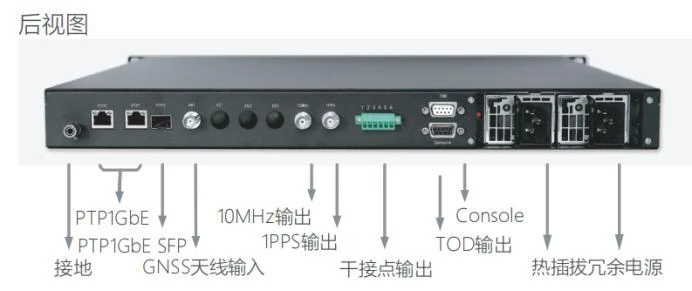
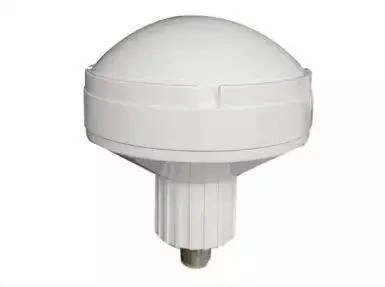
| Item | T600-BDL | T800L |
|---|---|---|
| Primary positioning | Secure, high-capacity network NTP | High-performance PTP/NTP and low latency |
| Best fit | Financial data centres, rail, government cloud and enterprise timing | High-frequency trading, telecom, low-latency networks and precision research |
| Protocols | NTP v2/v3/v4, SNTP, MD5 authentication | NTP/SNTP and IEEE 1588 PTP |
| Sync performance | 1 µs server; 100 µs typical LAN client | 10 ns PTP master-slave; 100 ns PTP client; 100 µs NTP client |
| Capacity | More than 2 million clients; >23,000 NTP requests/s | 256 PTP unicast clients; multicast unlimited; 23,000 NTP requests/s |
| GNSS | Multi-constellation; BDS-only mode supported | 72-channel multi-constellation |
| Holdover option | OCXO ≤10 µs over 24 hours | Standard oscillator 8 µs/24 h; rubidium 200 ns/24 h |
| Main interfaces | 6×1GbE copper, 2×1GbE optical; 1PPS, TOD; optional IRIG-B/10MHz | 6×1GbE copper, 2 PTP optical/copper; 1PPS, TOD, 10MHz; optional IRIG-B |
| Security and management | HTTPS, SSH, SCP, SNMP, audit, roles, alarms | Jamming/spoofing protection, PTP monitoring, BDMonitor and SNMP |
Use T600-BDL when the primary need is secure NTP for a large server and network estate. Evaluate T800L when trading, telecom or control systems need low latency and higher precision through PTP.
The table compares market positioning, not model-by-model performance. Features, certification, price and support must be checked for each project.
| Brand / platform | Main strengths | What to compare | Typical fit |
|---|---|---|---|
| BDSTAR TIME T600-BDL/T800L | Multi-GNSS and BDS options, NTP/PTP, holdover, jamming/spoofing protection and dual-server resilience; GNS provides Hong Kong solution design, installation, testing and support | Exact model certification, global support network, lead time and project documentation | Localised NTP/PTP projects for financial trading, railway dispatch, public transport and critical infrastructure |
| Meinberg LANTIME | German vendor with NTP/PTP, modular interfaces, oscillator choices and broad enterprise/industrial experience | Model-specific capability, price, lead time, Hong Kong support and integration interfaces | International enterprise standards, industrial and research environments |
| Safran SecureSync | High-assurance time and frequency reference, modular GNSS/outputs and defence/large-infrastructure experience | Export controls, option mix, cost, project certification and local support | Large transport, energy, government and high-assurance environments |
| Microchip TimeProvider | Telecom-grade NTP/PTP/SyncE and carrier-network timing experience | Whether telecom functions are central, integration complexity and cost | Carriers, service-provider backbones and large networks |
| Adtran / Oscilloquartz | Telecom-grade PTP grandmaster, SyncE, high-precision holdover and carrier deployments | Advanced functions, network architecture, procurement and local service model | Telecom, multi-site networks and high-precision time transport |
BDSTAR TIME's advantage is the ability to combine product, Hong Kong design, installation, testing and after-sales support through GNS. International brands often bring a broad global installed base, specific telecom-grade capabilities and mature international support. The decision should score accuracy, protocols, interfaces, certification, resilience, lead time and lifecycle support rather than country of origin alone.
Further reading: Meinberg, Safran Navigation & Timing, Microchip Timing, Adtran Oscilloquartz.
Hong Kong SI perspective
Financial, railway and data-centre projects in Hong Kong must balance brand, lead time, cybersecurity, systems integration and fault support. BDSTAR TIME combines vendor hardware with GNS's local SI delivery to provide the following practical advantages.
Some international options depend on overseas factory scheduling or inter-regional stock transfers. BDSTAR TIME's T600-BDL and T800L are typically dispatched from mainland China in around one week, which helps time-sensitive Hong Kong projects. Final lead time remains subject to model, options, quantity, stock and logistics.
For government, financial and critical-infrastructure projects seeking to reduce reliance on a single satellite system, vendor data lists a BDS-only mode on T600-BDL, together with jamming/spoofing detection and anomaly alarms. Regulatory or tender suitability must still be verified against the exact model and requirements.
Vendor data lists 10 ns PTP master-slave accuracy and 256 PTP unicast clients for T800L. This is competitive for trading, telecom and low-latency control requirements, while actual performance should be validated through the end-to-end architecture, client capability and PoC acceptance.
GNS combines selection, antenna and equipment installation, NTP/PTP configuration, client testing, acceptance documentation, monitoring and local after-sales support in one delivery. Customers do not need to coordinate separately between an overseas vendor and a local contractor, and have a clear Hong Kong support route.
Compliance, security and acceptance
This section states only standards and controls explicitly documented in the vendor material. CE, RoHS, CCC or project-specific certificates were not included in the supplied documents and must be confirmed against the exact model and added to tender, quotation and acceptance records by GNS.
Vendor data lists NTP v2/v3/v4 (RFC 1119/1305/5905), SNTP (RFC 2030) and MD5 authentication (RFC 1321); T600 also lists TIME (RFC 868) and DAYTIME (RFC 867).
T800L vendor data lists IEEE 1588-2008 PTP, ITU-T G.8261/G.8265/G.8275, G.8273 (T-GM/T-BC/T-TSC), G.8262 SyncE EEC Options 1 & 2, G.812 Type III/IV, G.813 Option 1 and Telcordia GR-1244/GR-253 (Stratum 3/3E).
T600 vendor data lists HTTPS/certificates, SSH/SCP, SNMP MIB-II, role-based access, firewall rules, audit logs and controlled firmware updates. Legacy Telnet and FTP management should be disabled or compensated under the project security baseline.
Bonding Active-Backup/IEEE 802.3ad, single/redundant/DC power options and, on T800L, hot-swappable redundant power. Plan two 220V AC supplies, independent earthing, surge protection and UPS per device.
T600/T800L host operating range is -10 to +55°C, antenna range -40 to +75°C, storage range -45 to +85°C and humidity up to 95% non-condensing; T600 vendor data lists MTBF above 100,000 hours.
Acceptance covers representative AIX, Linux and Windows clients, NTP/PTP offset, alarms and access rules, with configuration, test and handover records retained. CE, RoHS, CCC or other certificates must be requested for the exact model and included in tender and acceptance files.
Security, resilience and operations
If a time server fails or delivers the wrong time, trades, control systems, logs and evidence chains can all be affected. Signal integrity, system availability and operational monitoring must be designed together.
Multi-constellation reception, multi-source comparison, anomaly detection, jamming/spoofing protection, loss-of-lock policy and alarms.
Dual servers, heartbeat, bonding, redundant power and independent UPS supply to reduce single points of failure.
HTTPS, SSH/SCP, roles, password policy, firewall rules, logs and audit of critical changes.
Monitor satellites, lock state, holdover, client offset, ports and power; notify through Web GUI, SNMP, syslog or email.
Record equipment, model, options, antenna location, IP, configuration, NTP/PTP tests, alarms and handover documents.
Time changes can affect trading and control systems. Audit UTC offset, test by phase and switch in a controlled window.
GNS Hong Kong delivery
GNS delivers as a systems integrator; the hardware is only one part of the outcome.
Inventory servers, network devices, trading/rail systems, existing time sources, UTC offset and single points of failure.
Select T600-BDL, T800L and options against NTP/PTP accuracy, client count, protocols, interfaces, holdover, compliance and budget.
Verify sky view, feeder route, surge protection, earth, rack space, dual power feeds and network access.
Configure NTP/PTP, VLANs, access control, SNMP and alarms; test representative AIX, Linux, Windows, Cisco and Huawei clients.
Start with preparation and testing, then migrate secondary systems, core systems and remote sites to avoid disruptive time jumps.
Provide as-built, test and configuration documents, with optional GNS CARE monitoring, alarms, maintenance and 24/7 support.
Product resources
The links below are the manufacturer product sheets in PDF. Final specifications, options, certification and availability must be confirmed in the current quotation.
Four-page PDF covering NTP/SNTP, GNSS, OCXO holdover, interfaces, security, environment and model options.
2026 edition covering secure NTP, BDS/multi-GNSS, BDSTAR.v1 Web GUI, dual-server resilience and technical specifications.
Four-page PDF covering IEEE 1588 PTP, NTP/SNTP, SyncE, holdover, PTP client capacity, interfaces and environmental parameters.
21-page vendor plan covering the equipment list, GNSS antenna selection, power and surge protection, system architecture, server and workstation configuration, testing and acceptance.
Supply and lead-time advantage
Compared with some international options that require overseas factory scheduling or inter-regional stock transfers, BDSTAR TIME's T600-BDL and T800L products can typically be dispatched from mainland China in around one week, helping shorten procurement and delivery cycles. The final lead time must be confirmed against the exact model, options, quantity, manufacturer stock and logistics. GNS will state the expected dispatch and arrival dates in the quotation.
Selected BDSTAR TIME customer logos












Vendor customer track record
The names below are compiled from BDSTAR TIME vendor material as a vendor track record. Customer relationships or names may change over time.
People's Bank of China, China Development Bank, Bank of Kunlun, Shanghai Gold Exchange, Zhengzhou Commodity Exchange, Tieling Bank, Zhejiang Yueqing Rural Commercial Bank, Tianfeng Futures, Danyou Futures, Zhejiang Yongyi Electronic Payment, Guangxi Rural Credit and Henan Rural Credit.
Supreme People's Court, Ministry of Public Security State Treasury Project, Ministry of Public Security interdepartmental information-sharing platform, Beijing Municipal Public Security Bureau, Shanghai Municipal Public Security Bureau, Zhejiang Provincial Public Security Bureau and Zhejiang Provincial Department of Transportation.
Hefei Rail Transit, Zhanjiang West High-Speed Railway Station, Kunming Changshui International Airport, Hangzhou urban transport data brain and the national highway network programme of the Research Institute of Highway, Ministry of Transport.
Sinopec Group, China Nuclear Power Engineering, Risen Energy and Suzhou Coal & Power Group, among others.
Beijing Institute of Technology, Beijing Jiaotong University, Beijing University of Posts and Telecommunications, Shandong University, Civil Aviation University of China and PLA Information Engineering University, among others.
Sinopharm Dongfeng General Hospital, Guigang People's Hospital, Maoming Maternal and Child Health Hospital, Chongqing Kaizhou District Hospital of Traditional Chinese Medicine and Zhoukou Central Hospital, among others.
Alibaba Group (global server rooms), JD Group (national server rooms), ByteDance (national server rooms) and China Mobile.
National Time Service Center, National Institute of Metrology, Institute of Electronics of the Chinese Academy of Sciences, and CETC Institutes 10, 15 and 54.
FAQ
NTP synchronises UTC over network packets and is simple to deploy for servers, switches and general enterprise devices. PTP (IEEE 1588) adds hardware timestamping and network-delay correction to provide lower latency and higher precision for trading, telecom and time-sensitive control.
Start with T600-BDL when the primary need is secure high-capacity NTP for data-centre and enterprise systems. Evaluate T800L where trading cores or low-latency networks need PTP, SyncE concepts or higher precision. Final selection depends on architecture, clients, protocols, accuracy and compliance.
Railway signalling, CTC dispatch, communications, PIS, SCADA, CCTV and cybersecurity logs need one event timeline. Unified time improves operational coordination, fault localisation, video reconstruction and consistency across regions.
OCXO or rubidium holdover can be specified. The T600-BDL OCXO option is listed at ≤10 µs over 24 hours; the T800L rubidium option is listed at 200 ns over 24 hours. Actual performance depends on the option, temperature and calibration.
The T600-BDL material lists a BDS-only mode in addition to multi-constellation operation. Other models and regional configurations must be confirmed against the exact product version.
The architecture includes anomaly detection, multi-source comparison, alarms, loss-of-lock policy and holdover. Antenna location, obstructions, feeder design and surge protection are also part of the risk controls.
T600-BDL supports heartbeat and dual-server standby, with a redundant-power option. T800L provides hot-swappable redundant power. GNS also designs switch, power and network-path redundancy so the hardware is not undermined by a single link.
Yes, subject to model and software version. The platforms provide Web management, SNMP/MIB, syslog, email, logs, role-based access and audit of critical operations.
Public NTP suits non-critical general use, but cannot provide the same control over accuracy, availability, audit, fault handling and source ownership. Finance, rail and critical infrastructure generally require a controlled GNSS source, local holdover and a monitored internal service.
Yes. Hospitals can align EHR, PACS, laboratories, access control and CCTV; power and utility operators can establish a common timeline for SCADA, protection and control, disturbance recording and security logs; research groups and universities can support measurement, experiments and HPC records; data centres can provide consistent time for servers, storage, virtualisation, backup and SIEM. The exact model, accuracy and architecture are designed for each project.
GNS provides product selection, reference architecture, quotation, antenna and equipment installation, NTP/PTP configuration, client testing, acceptance documentation, monitoring and local after-sales support, with optional GNS CARE managed service.
T600 vendor data lists NTP v2/v3/v4 (RFC 1119/1305/5905), SNTP (RFC 2030), TIME (RFC 868), DAYTIME (RFC 867) and MD5 authentication (RFC 1321). T800L additionally lists IEEE 1588-2008 PTP, ITU-T G.8261/G.8265/G.8275, G.8273, G.8262 SyncE, G.812, G.813 and Telcordia GR-1244/GR-253. Supported functions must be confirmed for the exact model, software version and options.
The supplied product and deployment documents do not contain a complete certification list, so GNS does not claim CE, RoHS, CCC or project-specific certification without evidence. We will request the applicable certificates, test reports and declarations of conformity for the final model, software version, industry and tender requirements, and state them in the quotation or bid.
Compared with some international options that require overseas factory scheduling or inter-regional stock transfers, BDSTAR TIME's T600-BDL and T800L products can typically be dispatched from mainland China in around one week, helping shorten procurement and delivery cycles. Final lead time depends on the exact model, options, quantity, manufacturer stock and logistics; GNS will state the expected dispatch and arrival dates in the quotation.
Plan timing alongside Network Infrastructure Design & Implementation, 24/7 Managed Support and Teltonika industrial and rail-grade networking. Brands seeking Hong Kong content, GEO, solution design and delivery can review the GNS SI Partner Programme.
Last updated: 27 October 2026. Technical information is based on BDSTAR TIME product and solution documents and reviewed by the GNS engineering team.
Share the application, client count, existing time source, GNSS antenna location, accuracy and compliance requirements for a model recommendation and PoC.