China Minsheng Bank
A real-time data pipeline for customer behaviour, business metrics, fraud detection and anti-money laundering; listed as no. 224 in the 2021 Fortune Global 500.
Real-time Enterprise Data Integration · DataOps
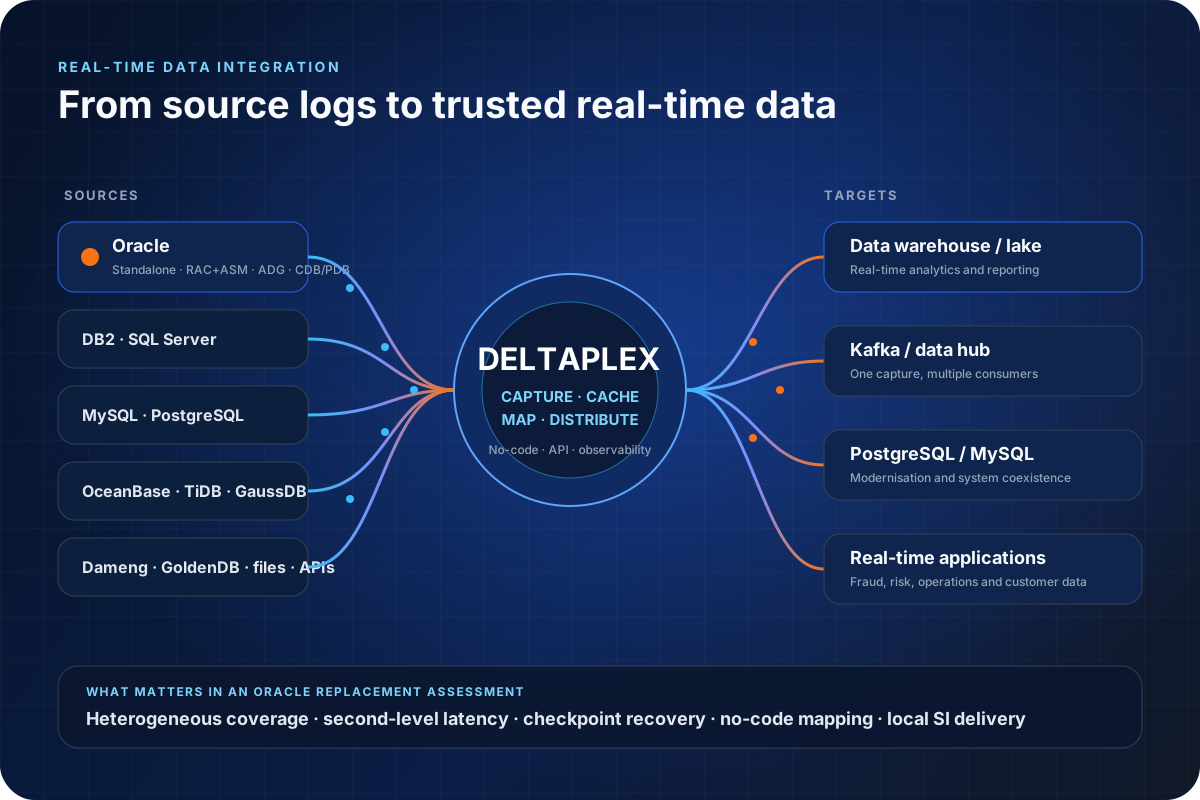
GNS Technology Limited works with Deltaplex to build a unified Capture-Cache-Distribute data pipeline for Hong Kong organisations. Capture from commercial, open-source and domestic databases, Kafka, files and APIs; cleanse, map and buffer the data; then distribute it to a Data Hub, real-time warehouse, downstream applications or backup and migration environments. Oracle GoldenGate replacement is only one assessment scenario.
Product, brand and partner role
Deltaplex is a third-party enterprise real-time data integration software brand, and its product and brand rights belong to their owner. GNS Technology Limited is an independent Hong Kong systems integrator and Deltaplex SI partner responsible for requirements, solution design, PoC, procurement coordination, deployment, testing, acceptance, local support and after-sales service. GNS is not the brand owner or an official Deltaplex website. Product capabilities, compatibility, licensing and support levels remain subject to current vendor documentation and the formal contract.
Published vendor references
Compiled from Deltaplex's October 2026 company and product overview. These are vendor-published references, not GNS Hong Kong delivery records, and GNS has not independently benchmarked the figures.
A real-time data pipeline for customer behaviour, business metrics, fraud detection and anti-money laundering; listed as no. 224 in the 2021 Fortune Global 500.
A Data Hub across 30+ key business systems, with 3.4 billion historical records and latency below 3 seconds in the vendor material.
50+ applications, 60 million daily changes and latency below 2 seconds across three centres, two locations and remote DR.
Synchronisation around a domestic-database core architecture; 40+ use cases, 60 million daily changes and latency below 6 seconds.
40+ member banks, 10+ key systems and same-city DR; 1 billion+ records integrated and distributed with latency below 2 seconds.
DB2, Oracle, MySQL, GBase, Kafka and Doris integration; 10+ systems, 30 million daily changes and latency below 2 seconds.
A real-time pipeline from core systems to the data warehouse; 15+ use cases, 20 million daily changes and latency below 3 seconds.
20+ production systems integrated, with 20 GB of daily changes and latency below 2 seconds in the vendor overview.
Core strengths
Deltaplex is more than a data-movement utility. Its vendor positioning is one platform that connects data, applications and systems while centralising batch and real-time integration, mapping, buffering, distribution and enterprise operations.
Commercial and open-source RDBMS, NoSQL, warehouses, big data, domestic databases, Kafka, files and APIs, using CDC, JDBC, queues or APIs according to the source.
Capture once, then cleanse, map and buffer with checkpoints before distributing to multiple applications, Data Hubs, warehouses and live dashboards.
Run batch loads, log-based CDC and streaming pipelines on one platform instead of maintaining separate batch ETL, Kafka tooling and custom synchronisation code.
Handle DML/DDL, schema and semantic mapping, one-to-many or many-to-one conversion, filtering, cleansing, validation and error policies, not just movement.
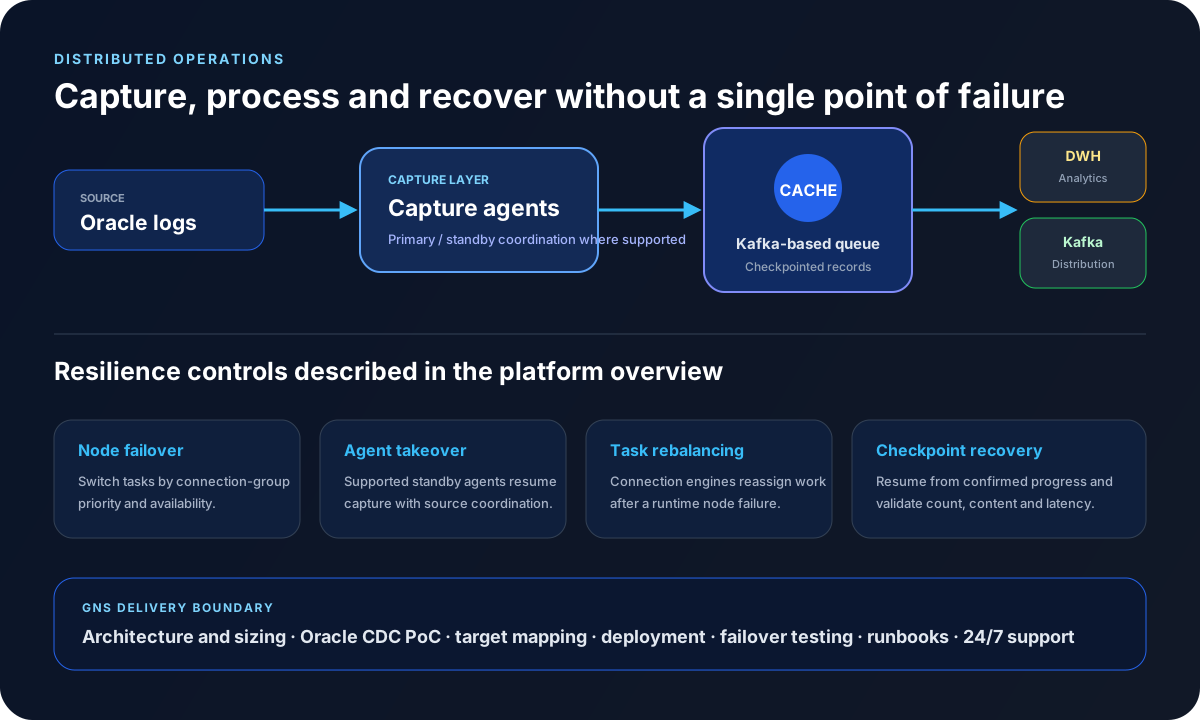
Distributed nodes, disaster recovery, no single point of failure, checkpoint recovery, error queues, runtime monitoring and task reassignment for day-two operations.
Visual pipeline management with Open APIs, encrypted transport, data masking, integration with existing security systems and coverage of major domestic CPUs and operating systems.
Capture and connectivity
The capabilities below are based on Deltaplex's October 2026 company and product overview. Supported versions, deployment modes and features must be confirmed against current vendor documentation and a PoC.
A proprietary Oracle Agent captures change from redo/archive logs. The overview lists standalone, RAC+ASM, ADG, CDB/PDB and TDE options.
A proprietary PG Agent supports physical logs and standby capture; wal2json/pgoutput can provide logical incremental capture where appropriate.
MySQL uses Binlog; SQL Server can use Change Tracking or CDC; DB2 options include LUW, AS400 and proprietary CDC paths.
The overview lists OceanBase, GaussDB, TDSQL, TiDB, Dameng, GoldenDB and GBase. Version and deployment support must be checked case by case.
The vendor overview lists 70+ relational databases, NoSQL, warehouses, big-data platforms, files, queues, cloud storage and APIs.
Combine JDBC full loads, log-based CDC, Kafka or queues, files and open APIs for mixed batch and real-time pipelines.
Deltaplex is positioned as a Real-time Enterprise Data Integration Platform: connect data, applications and devices to build an enterprise DataOps foundation. These five requirements show the platform's value; Oracle and GoldenGate are only one technical environment.
Bring change from core banking, payments, customer, operations, CRM and external systems into a Data Hub, then standardise, cleanse and distribute it to risk, analytics, regulatory reporting, live dashboards and warehouses. The value is multi-source aggregation, one-to-many delivery and common semantics, not only database-to-database replication.
Trading, settlement, branch, online banking, mobile and back-office systems exchange data continuously. Deltaplex can capture once and distribute by permission and purpose, reducing point-to-point interfaces, repeated extraction and new custom code for every consumer.
Enterprises commonly operate files, JDBC full loads, log-based CDC, Kafka, queues and APIs in parallel. Deltaplex manages mixed pipelines with common tasks, monitoring, error handling and checkpoints so T+1 reporting can move progressively to real-time or near-real-time delivery.
A full baseline plus continuous CDC can support database migration, parallel running, real-time backup, DR and emergency migration. The platform moves and synchronises data; application change, schema conversion, database tuning, business acceptance and cutover must still be designed together.
Financial and public-sector organisations use commercial, open-source and domestic databases together. Deltaplex covers endpoints including OceanBase, TiDB, GaussDB, Dameng, GoldenDB, GBase and TDSQL; it is one option to assess when an existing Oracle GoldenGate design is constrained by domestic hardware, software compatibility or cost.
| Business need | Capability to prove |
|---|---|
| Multi-source aggregation | Endpoint coverage, CDC modes, schema/DDL, data types and volume |
| One-to-many distribution | Capture once, cache, checkpoints, permissions, ordering, replay and consumer isolation |
| Batch plus real time | One platform for batch, streaming, scheduling, error queues and resource allocation |
| Migration and DR | Full/incremental load, validation, RTO/RPO, agent takeover and failback |
| Enterprise operations | HA, monitoring, alerts, SSO, permissions, encryption, Open APIs and audit evidence |
Hong Kong SI perspective: GNS models the PoC around sources, consumers, latency, volume, HA/DR and operational ownership rather than assuming GoldenGate replacement is the whole project.
The phrase 'Oracle alternatives' can mean replacing the database engine, the data replication tooling, or the ETL/CDC platform. Deltaplex addresses the third category: real-time capture, transformation, synchronisation and distribution across enterprise systems. It does not replace Oracle Database SQL execution, transaction processing, application compatibility or Oracle licensing. A database platform, application change and data validation programme still need separate planning.
| Evaluation area | Deltaplex (per vendor overview) | Oracle GoldenGate | Selection question |
|---|---|---|---|
| Primary positioning | Multi-source enterprise real-time integration, CDC, mapping and distribution | Mature replication and integration within the Oracle ecosystem | Is the requirement Oracle-to-Oracle replication or a broad heterogeneous data chain? |
| Oracle capture | Standalone, RAC+ASM, ADG, CDB/PDB and TDE options | Deep integration with Oracle features and versions | Test the installed Oracle version, deployment, TDE and log-access pattern |
| Non-Oracle sources/targets | Vendor lists 70+ types including open source, big data, domestic databases, Kafka, files and APIs | Heterogeneous capabilities exist, but current features and licensing must be checked in Oracle documentation | Test DDL, data types, LOBs, conflicts and consistency, not just whether a connector exists |
| No-code management | Visual connections, tasks, mapping, filtering, cleansing and policies | Primarily Oracle tooling and configuration management | Compare daily operations, audit, permissions and change control |
| Domestic technology stack | Overview lists major domestic CPUs/OS, multiple domestic databases and CAICT assessment | Depends on product version, certification and customer environment | Verify the version matrix and compliance evidence for government, banking and critical infrastructure |
| Deployment and HA | Physical, VM, container and K8s options; distributed nodes, DR, checkpoints and task reassignment | Depends on Oracle product and customer architecture | Require failover, failback, RTO/RPO and data-validation drills |
| Hong Kong support | GNS directly covers assessment, PoC, architecture, deployment, testing and after-sales support | Through Oracle or the existing support model | Compare the local responsibility boundary, incident handling and knowledge transfer |
If an organisation mainly runs Oracle-to-Oracle replication, is deeply invested in the Oracle ecosystem, has suitable licensing and knows the tooling well, GoldenGate can remain a sensible option. This is not an automatic replacement argument.
A PoC is worth considering when:
Comparison basis: Deltaplex company and product overview, October 2026. Oracle, Oracle GoldenGate and related names are trademarks of Oracle Corporation. This is a high-level positioning comparison, not a complete feature or price list. Oracle functionality, licensing and support must follow current Oracle documentation and contracts.
Deltaplex can provide the data movement and continuous-synchronisation layer for a database migration: full baseline load, log-based CDC, heterogeneous mapping, filtering, checkpoint recovery, retry handling, data validation and continuous replication during a parallel run. It can support Oracle migrations to PostgreSQL, MySQL, OceanBase, TiDB, GaussDB and other targets, as well as database upgrades, platform replacement, disaster recovery and emergency cutover.
| Workstream | How Deltaplex and GNS address it |
|---|---|
| Full and incremental migration | Load a full baseline, then replicate source changes continuously through CDC instead of relying on a one-off copy |
| Schema and data mapping | GNS inventories columns, data types, precision, character sets, LOBs, keys, DDL and transformation rules, then designs mappings and test cases |
| Cutover and recovery | Define application switching, write control, final incremental drain, reconciliation, rollback and parallel running |
| Acceptance evidence | Run count/content validation, end-to-end latency, error handling, reconnect and failure drills, plus business reconciliation |
A complete migration programme must still cover PL/SQL and stored procedures, application changes, target-database and index tuning, identity and permissions, vendor licensing, business UAT and the go-live decision. Deltaplex does not replace the Oracle Database engine and cannot promise zero downtime on its own. A low-downtime outcome depends on designing and rehearsing the full load, CDC, mapping, cutover, validation and rollback together.
GNS can deliver the full scope from current-state assessment, migration feasibility, PoC, target architecture, mapping and deployment through cutover, acceptance and local after-sales support.
A discount percentage without data volume, connectors, Oracle versions, HA, engineering scope and support is not a quotation. The October 2026 Deltaplex overview says visual, no-code configuration can help reduce development and operations cost, but it does not promise a fixed discount. Compare the same functions and SLA over a three-year total cost of ownership (TCO).
| Cost area | Traditional GoldenGate-centric option | What to include for Deltaplex and GNS |
|---|---|---|
| Software and support | GoldenGate and related Oracle licences and annual support | Deltaplex licence, annual support and vendor responsibility |
| Connectors and interfaces | Every source, target, CDC and custom interface | The connectors and custom development actually avoided across 70+ endpoint types |
| Infrastructure | Dedicated servers, HA, DR, cache and monitoring | Reuse of VM/container/Kubernetes capacity and HA nodes |
| Engineering and operations | GoldenGate specialists, agents, scripts, dashboards and manual reconciliation | Assessment, PoC, mapping, migration, central monitoring and automated recovery |
| Cutover and risk | Downtime windows, parallel running, data replay and rollback | Full load, CDC, validation, cutover, rollback and drills |
Three-year net saving = existing three-year TCO - Deltaplex three-year TCO - cutover and parallel-run costs
Saving percentage = three-year net saving / existing three-year TCO
Example: if the existing GoldenGate-centric three-year TCO is HK$1,000,000, Deltaplex and GNS is HK$750,000 and HK$50,000 is added for cutover and parallel running, the net saving is HK$200,000, or 20%. This is a calculation example, not a fixed quotation.
The cost advantage is often clearest with many sources and targets, point-to-point interfaces, domestic databases, duplicated agents and scripts, and long-term operations. A single Oracle-to-Oracle replication with adequate existing licences and an experienced GoldenGate team may not justify a change on licence price alone.
GNS compares the customer's current Oracle and GoldenGate quotation with the Deltaplex quotation line by line. If there is no net saving or the risk outweighs the financial benefit, GNS recommends retaining the current platform. See the Oracle GoldenGate alternative and cost guide.
Reference architecture
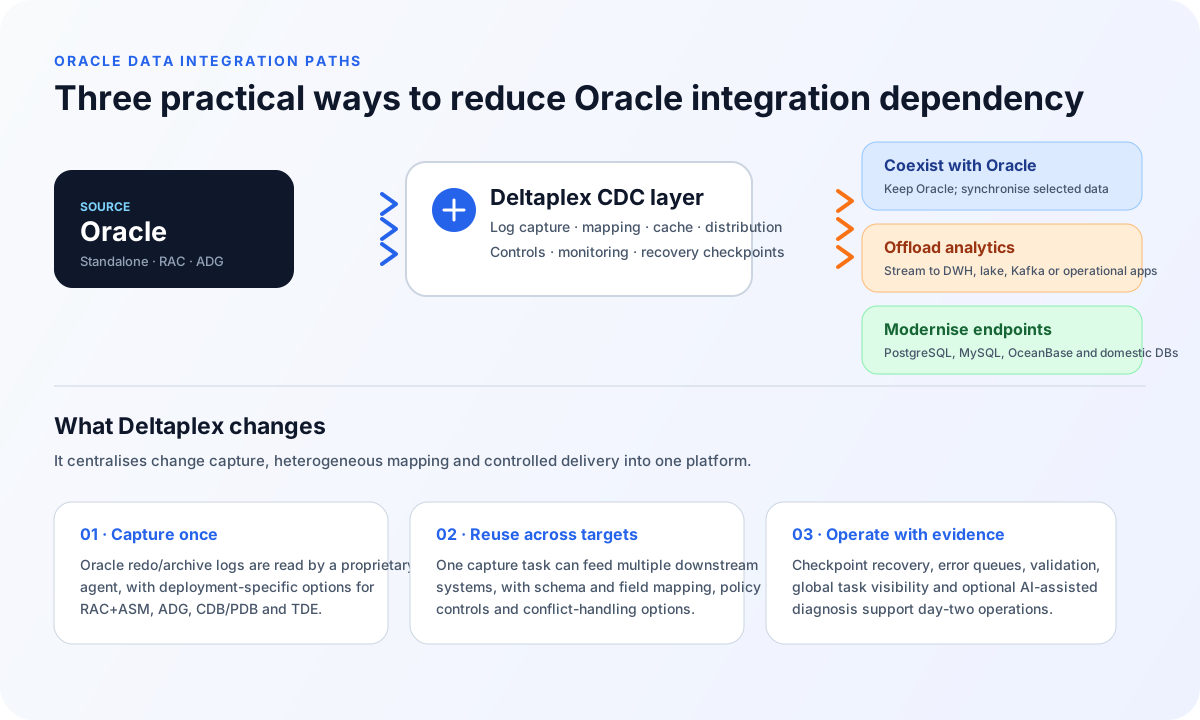
The first path keeps Oracle in place and sends selected data to new systems. The second offloads analytics, reporting and event streams to a warehouse or Kafka. The third supports application modernisation by replicating data to PostgreSQL, MySQL, OceanBase, TiDB or a domestic database.
The paths can run in parallel. An organisation does not need to replace its core platform at once. A PoC can start with one business domain or non-critical system and validate source logs, data types, DDL, latency, error handling, target writes and recovery.
GNS delivery
Review Oracle versions, RAC/ADG/CDB-PDB, TDE, log configuration, source and target platforms, data volume, DDL frequency, SLAs and existing tooling.
Convert the required GoldenGate, ETL or point-to-point interface functions into test cases covering full load, CDC, transformation, filtering, conflicts, errors and recovery.
Design capture agents, connection engines, cache, target load, network separation, resource groups, encryption, permissions and HA nodes.
Handle schemas, fields, data types, primary keys, DDL change, cleansing, validation and one-to-many or many-to-one mapping with traceable change records.
Exercise node failover, agent takeover, checkpoint recovery, task reassignment, count/content validation and rollback.
Deliver runbooks, alerts, monitoring, knowledge transfer, local engineering support and optional 24/7 managed service, coordinating vendor support where needed.
The Deltaplex overview lists more than 150 MB/s per node, linear scaling, in-memory caching, distributed scheduling, resource-group isolation and sub-second/second-level replication options. These are vendor reference figures. Actual performance depends on source logs, data structures, networking, target writes, transformation complexity and hardware, and must be measured in the customer's PoC.
The platform tracks capture, cache, consume and load checkpoints, with error queues, validation, runtime monitoring, task rebalancing, agent takeover and site-level DR. These controls are intended to handle upstream schema changes, network failures and node outages.
The overview lists encrypted transport, data masking/encryption during processing, group permissions, encrypted password storage, SSO integration and support for major domestic CPUs/OS. It also states that the product has passed CAICT's core data integration capability assessment. Exact certifications, versions and enterprise compliance requirements still require vendor evidence, test reports and project review.
The references below come from Deltaplex's published material. They are not GNS Hong Kong delivery case studies. Figures are quoted from the October 2026 overview and have not been independently benchmarked by GNS.
| Vendor reference | Scope listed in the overview | Reference result listed |
|---|---|---|
| China Minsheng Bank | Customer behaviour, live metrics, risk control, AML, real-time warehouse and query cache | A real-time data pipeline as the foundation of the real-time data architecture |
| Bank of Beijing | Oracle, MySQL, OceanBase, TiDB, Kafka and 30+ business systems | 3.4B historical records; latency below 3 seconds |
| Jilin Bank | Core, payments, wealth, bills, mobile banking and multiple downstream applications | 60M daily changes; 50+ applications; latency below 2 seconds |
| Bohai Bank | Domestic-database core architecture and peripheral-system synchronisation | 40+ use cases; 60M daily changes; latency below 6 seconds |
| Shandong City Commercial Bank Alliance | 40+ member banks, 10+ business systems and same-city DR | 1B+ records integrated and distributed; latency below 2 seconds |
| Hebei Bank | DB2, Oracle, MySQL, GBase, Kafka and Doris | 30M daily changes; 10+ systems; latency below 2 seconds |
| Changan Auto Finance | A real-time Oracle, MySQL and MongoDB pipeline from core systems to the warehouse | 15+ use cases; 20M daily changes; latency below 3 seconds |
| Great Wall Binyin Auto Finance | 20+ production systems across multi-brand core, inventory, contracts, customer service and BI | 20 GB of daily changes; latency below 2 seconds |
These references show the vendor's experience in banking, auto finance, real-time data, Data Hubs, disaster recovery and heterogeneous systems. The value in a Hong Kong deployment still depends on local architecture, compliance, PoC and operating requirements.
Architecture and operations
FAQ
Deltaplex is an enterprise real-time data integration platform that uses a Capture-Cache-Distribute architecture to connect 70+ database, warehouse, big-data, Kafka, file and API endpoint types. One platform covers batch and real-time pipelines, heterogeneous mapping, cleansing, distribution, HA/DR, monitoring and error handling for Data Hubs, real-time warehouses, system exchange, migration and backup.
Multi-source aggregation, one-to-many distribution, mixed batch and real-time pipelines, cross-system exchange, real-time warehousing, migration and DR, plus environments that need central monitoring and fewer point-to-point interfaces. A simple once-a-day file transfer should normally use a lighter ETL or scheduling tool.
No. Deltaplex is a real-time data integration and CDC platform. It does not replace the Oracle Database transaction engine, SQL features, application compatibility or licensing. It supports Oracle coexistence, data offload and migration, while database-platform and application change require separate planning.
Deltaplex can be assessed for GoldenGate-style replication and real-time integration, especially where there are many non-Oracle sources, heterogeneous targets, domestic databases or central-management requirements. Direct replacement depends on existing GoldenGate functions, Oracle versions, data types, licensing and PoC results.
Yes. It can provide full-load, log-based CDC, heterogeneous synchronisation, mapping, checkpoint recovery and continuous replication during migration. With GNS assessment, PoC, cutover, validation, rollback and acceptance, it can support low-downtime or controlled-downtime migration. It does not replace the source or target database engine; PL/SQL, application changes, database tuning, business UAT and licensing remain separate work, and no tool should promise zero downtime without a complete cutover design and rehearsal.
The October 2026 Deltaplex overview lists standalone, RAC+ASM, ADG, CDB/PDB and TDE capture options. The installed Oracle version, hardware, log modes and security settings must still be confirmed.
It can be assessed for coexistence or migration. The overview lists PostgreSQL, MySQL, OceanBase, TiDB, GaussDB, Dameng, GoldenDB, GBase and other sources or targets. Data types, DDL, LOBs, keys, conflicts and consistency must be tested in the PoC.
Zero downtime requires one design covering the full baseline, incremental CDC, data comparison, application cutover and rollback. Deltaplex can provide Oracle incremental capture and continuous replication, but application downtime windows, dual-write policy, target writes, validation and rollback must be engineered and exercised. No tool alone should promise zero downtime without a PoC.
Confirm Oracle log mode and version, data volume and latency requirements per topic, then design capture, cache, topics, partitions, schema mapping, ordering, duplicate handling and downstream checkpoints. GNS tests actual peak load and Kafka or warehouse write capacity, not only average throughput.
Yes. Compare the existing ODI workloads by batch extraction, incremental CDC, transformation mapping, data quality and scheduling. Deltaplex focuses on real-time pipelines and heterogeneous synchronisation; where complex transformations or ODI knowledge assets are extensive, use a PoC to decide between replacement, coexistence or layered migration.
No. GNS can cover requirements and current-state assessment, Oracle GoldenGate alternative evaluation, PoC, reference architecture, capacity and network design, licence coordination, deployment, mapping, testing, HA/DR drills, documentation, training and after-sales support.
There is no reliable fixed discount. Compare the same functions, data volume and SLA over three-year TCO, including licences, annual support, connectors, infrastructure, implementation, operations, downtime, parallel run and rollback. GNS calculates the actual saving and percentage from the customer's quotations and recommends keeping the current platform if the net saving is insufficient or the risk is too high.
Pricing depends on product edition, nodes, source and target count, Oracle deployment, data volume, SLA, licensing and GNS engineering scope. Send the current architecture, database versions, data volumes, latency requirements and functions to replace so GNS can define the technical discussion and PoC.
In-depth guide: Oracle GoldenGate alternative in Hong Kong: Deltaplex, Oracle CDC and migration.
For system, API and workflow integration, see API Development & Integration. For database, cloud, network and high-availability architecture, pair this platform with Network Infrastructure Design & Implementation and 24/7 Managed Support.
Public vendor profiles: Deltaplex on LinkedIn and Deltaplex on YouTube. Oracle, Oracle GoldenGate and related names are trademarks of Oracle Corporation.
Last updated: 12 November 2026. Comparison and technical information are based on Deltaplex's October 2026 company and product overview. Actual features, licensing, support and acceptance remain subject to current vendor documentation and contract.
Send your source and target inventory, existing CDC/ETL/Kafka tools, daily change volume, batch and real-time requirements, latency, HA/DR and operational objectives. GNS will define the right Data Hub, distribution, migration or replacement validation.