GNS Homepage Reaches 86% GEO Coverage: Brands Need More Than Product Uploads to Be Cited by AI
GNS Engineering Team 6 min read
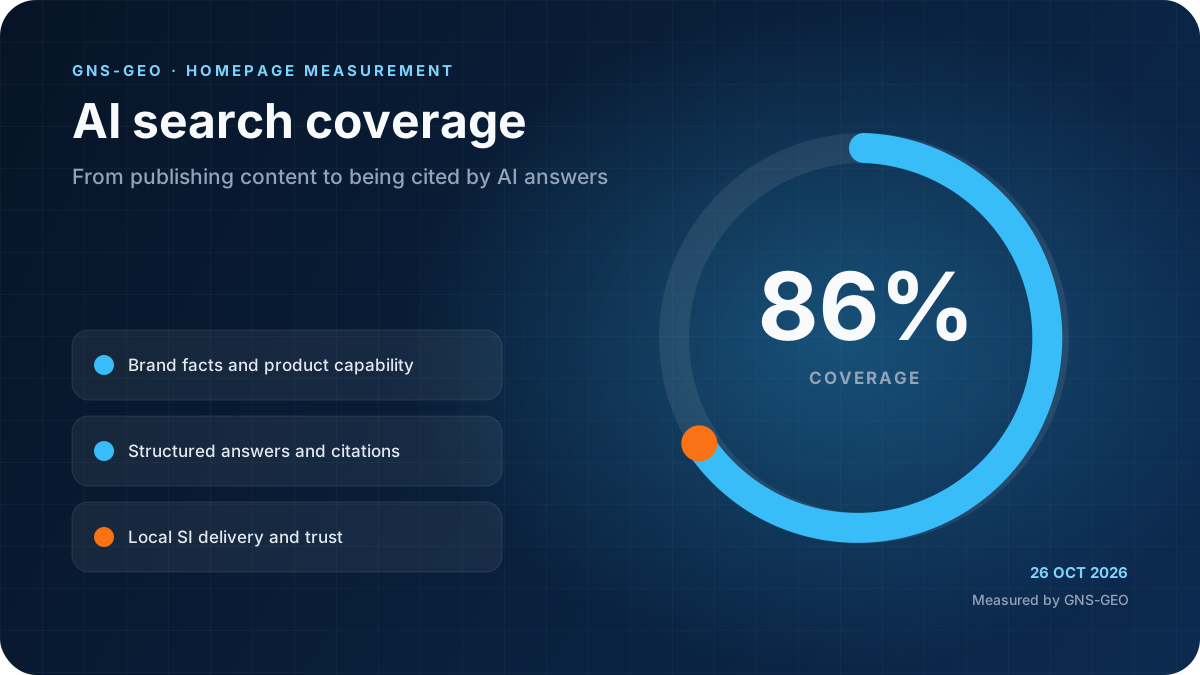
GNS's homepage achieved 86% coverage in the latest GNS-GEO measurement. The figure is not a page count or a one-off search ranking. It means that, across the defined set of tested questions, AI could find, understand or cite GNS in most answers.
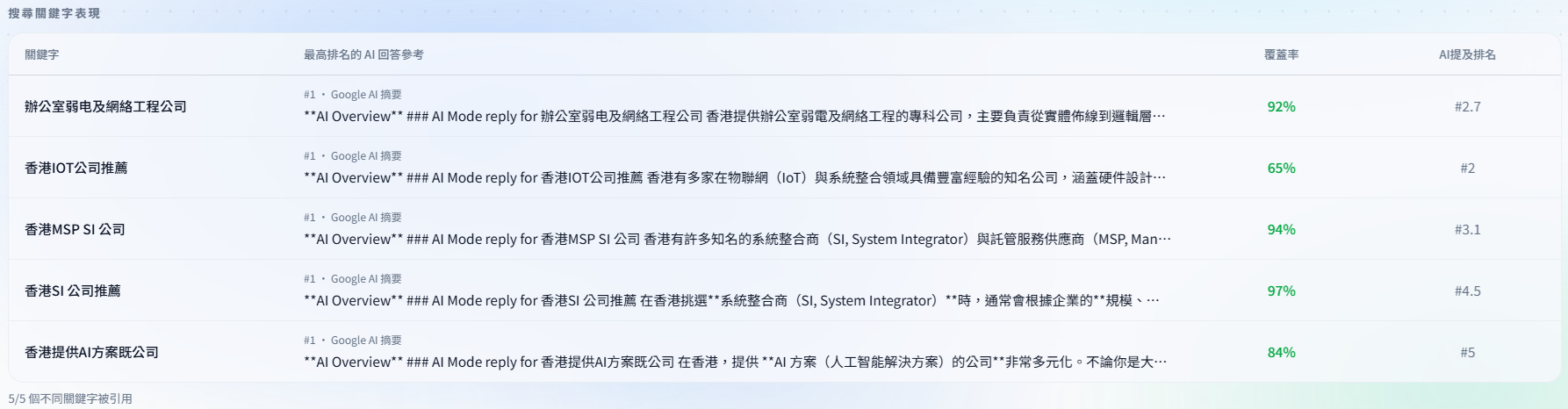
Screenshot: the latest GNS homepage GEO measurement on 26 October 2026. AI answers vary by platform, time and question. The 86% result applies to this monitoring set and is not a permanent guarantee for every query.
The result illustrates an important shift: publishing information online does not mean AI understands, trusts or recommends a brand. Effective GEO turns product knowledge, solution capability, evidence and local support into facts that AI can cite.
What 86% coverage means
When a customer asks AI which company can deliver a system in Hong Kong, which product fits a particular environment or which brand meets a requirement, the AI synthesises an answer before selecting its sources. Unlike traditional search, it does not simply show ten blue links.
Coverage measures how often a brand appears across the defined question set. At 86%, GNS's content is sufficiently clear, readable and credible for AI to find and use across most tested questions.
It does not mean:
- every question will mention GNS;
- every generated answer and citation list will be identical;
- the brand permanently holds first place;
- every AI platform has exactly the same understanding of the brand.
It means the brand has a measurable foundation that can be monitored and improved, rather than relying on a one-off advertising impression.
Uploading product data is only the starting point
Many brands assume that publishing specifications, images and sales material will lead AI to recommend the product automatically. In practice, fragmented product information often has several problems:
- product names, use cases and market positioning are inconsistent;
- pages list features but do not answer real customer questions;
- verifiable cases, tests, certifications and delivery scope are missing;
- the same product is described differently across websites;
- structured data does not clarify the relationship between brand, product, location and service;
- nobody monitors whether AI understands the brand correctly after publication.
GEO is therefore not a one-time product upload. It is a content system that converts brand knowledge into information AI can understand, trust and cite.
Six layers of effective GEO
1. Brand and product entities
Standardise the brand name, company details, product names, model codes, partner role and service territory. AI must be able to identify the brand, what it sells and who supports it in Hong Kong.
2. Question-led content
Customers do not only search model numbers. They ask whether a product fits their environment, how it is installed, how it differs from alternatives, and where they can buy and support it locally. High-intent questions need direct answers.
3. Structured data and technical markup
FAQPage, Article, Organization, Product and Service markup make important facts machine-readable. They do not replace good content, but they reduce the chance of AI misunderstanding the page.
4. Cases, numbers and verifiable evidence
AI is more likely to cite information that is specific, consistent and verifiable. Project scope, deployment method, certifications, testing approach, delivery figures and public links are more useful than generic marketing claims.
5. Localisation and trust
For Hong Kong customers, an international brand does not automatically mean there is local support. Clear sales, installation, testing, warranty, after-sales and contact details improve confidence for both AI and the buyer.
6. Continuous monitoring and correction
AI models and competing content change. GEO requires regular re-testing of target questions, checking whether the brand is mentioned and described correctly, reviewing citation sources and comparing competitor visibility.
GEO optimisation belongs inside the solution
A website launch gives a brand a set of pages. GEO turns those pages into a market entry point that AI search can understand, cite and recommend.
The scope includes:
- product and solution page architecture;
- target questions and FAQs;
- structured data;
- consistent brand, product and contact information;
- cases and comparison content;
- internal links and external citations;
- AI-visibility testing and ongoing correction.
The outcome is not just more visibility. When a buyer researches a relevant product, AI can provide a more complete, accurate and credible answer, helping the customer build trust before contacting the sales team.
The GNS SI partnership: you bring the solution; we take it to market and deliver it
GNS is not only a web-development supplier and not only a reseller. For brands entering Hong Kong, GNS offers a route that combines GEO, content, sales development, system integration and local delivery.
The brand provides:
- product technology, features and version information;
- manufacturer positioning, demonstrations and technical support;
- certifications, testing and compliance documents;
- pricing policy and partnership terms.
GNS provides:
- Hong Kong market messaging and localisation;
- GEO content architecture and AI-search optimisation;
- brand, product and case-study pages;
- structured data, FAQs and citation strategy;
- joint promotion and lead development;
- solution design, installation, integration, testing and acceptance;
- local after-sales support and ongoing content updates.
This division keeps product and technology leadership with the brand while a Hong Kong team handles promotion, adoption and delivery.
Why promotion and delivery must work together
Promotion alone still leaves the buyer asking: who installs the product in Hong Kong, who supports it when something fails, can it integrate with our systems, and will testing and acceptance documents be provided?
Sales and installation without GEO are equally limited: the buyer may never find the brand during the AI research stage.
The GNS SI model connects both sides:
- The brand provides the product and solution.
- GNS turns technical information into content that Hong Kong buyers and AI can understand.
- Buyers discover the brand through AI search.
- GNS handles the enquiry, solution design and local delivery.
- The completed project becomes another citable case, strengthening the next GEO cycle.
Content, trust and delivery reinforce one another.
Brands that fit the programme
The GNS SI Partner Programme is particularly relevant to hardware, software and cloud brands targeting:
- government and public bodies;
- rail, transport and logistics;
- education, healthcare and large facilities;
- industry, manufacturing and property management;
- Hong Kong SMEs and multi-site enterprises.
A brand does not need to establish a full Hong Kong team before starting. GNS can handle market content, GEO, solution integration and local support, expanding by partnership stage.
Five steps from content to commercial delivery
- Define the partnership: product, target market, support responsibility and commercial model.
- Audit the brand and product: verify technical facts, certifications, cases and target questions.
- Build the GEO layer: product pages, solution pages, FAQs, structured data and comparison content.
- Measure and optimise: track AI mentions, coverage, description accuracy and citation sources.
- Sell and deliver: GNS handles enquiries, design, installation, testing and after-sales, then turns the project into a local case study.
Summary
The GNS homepage's 86% GEO coverage demonstrates that a brand can become part of AI answers when its expertise is expressed through the right structure, credible facts and continuous measurement. Publication alone is not enough.
Competition now takes place not only on product features, but on who can clearly explain value, build trust and provide verifiable local support inside AI platforms.
Brands with a defined product or solution can review the GNS SI Partner Programme.
You bring the solution; GNS takes it to market and delivers it on the ground.
FAQ
What does the GNS homepage's 86% GEO coverage mean?
86% is the proportion of the defined monitoring set in which GNS content or the GNS brand appeared in AI answers. It shows that, across most tested questions, AI could find, understand or cite GNS. It does not mean every question or every AI response will mention GNS, and it is not the same as being ranked first.
Why is uploading product information not enough for GEO?
AI does not automatically understand disconnected product pages. Better citation performance requires clear brand and product entities, question-led content, consistent names and technical facts, structured data, verifiable cases, internal and external links, and continuous testing. Uploading content completes publication; it does not complete GEO.
How does GNS's SI partnership model work with a brand?
The brand owns product technology, positioning, demonstrations and manufacturer support. GNS owns Hong Kong content, GEO architecture, structured data, cases, promotion, solution integration, installation, acceptance and local after-sales support. In short: you bring the solution, and GNS takes it to market and delivers it on the ground.
Is GEO the same as SEO?
The goals overlap, but the focus differs. Traditional SEO primarily competes for search-result rankings and clicks. GEO focuses on whether a brand is mentioned, described accurately and cited in an AI-generated answer. Clear entities, verifiable facts, FAQ coverage, comparisons and third-party evidence are especially important.
Which brands are a good fit for a GNS partnership?
The programme suits hardware, software and cloud brands with a real product or solution that want to reach Hong Kong government, public-sector, enterprise, education, healthcare, rail, logistics or industrial customers. A brand can provide the technical product and core information while GNS develops the market content, GEO strategy and delivery model.
Will GEO performance continue to be measured after 86%?
Yes. AI answers and citations change as models, competitor content and market questions evolve. GEO requires ongoing testing of question coverage, description accuracy, citation sources and competitor gaps, followed by content updates. A one-off launch is not enough.