Nocoly HAP use cases compared with OutSystems, Kintone, Power Apps and Airtable
 Anson Ng 10 min read
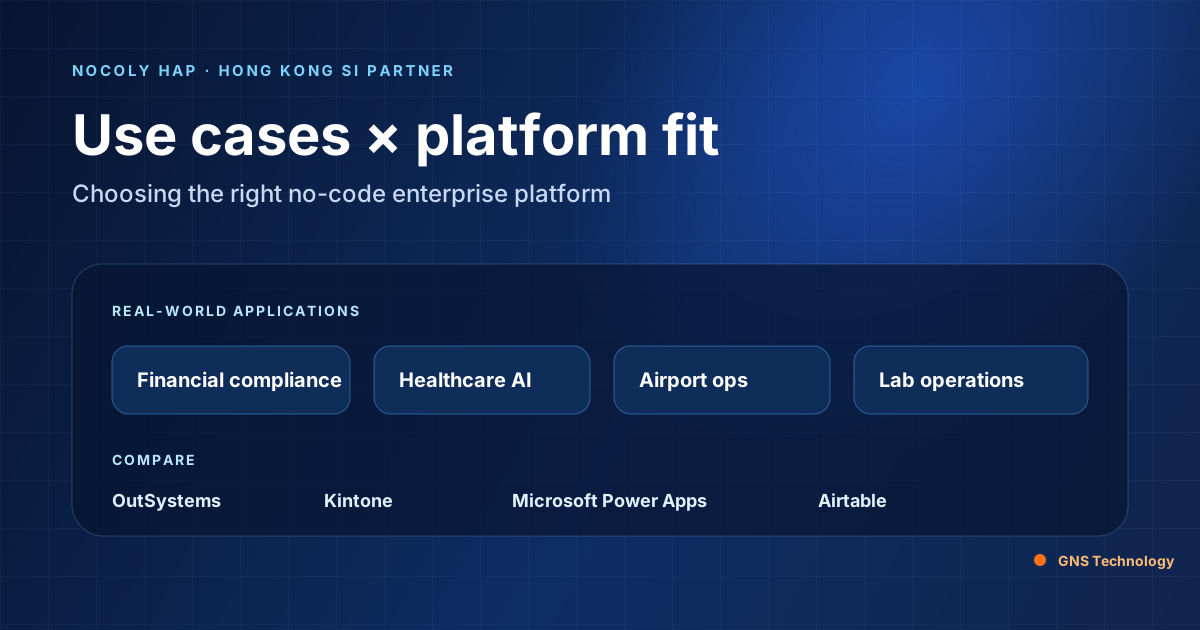
Nocoly HAP, OutSystems, Kintone, Microsoft Power Apps and Airtable can all build business applications, but they are designed around different priorities. A feature checklist makes the platforms look more similar than they are. The practical decision usually depends on deployment, process complexity, integration, permissions, budget and who supports the application after launch.
Nocoly HAP is not positioned as a replacement for every professional development platform. It focuses on governed internal enterprise applications that business and IT teams can build together. Worksheets, views, workflows, permissions, charts, custom pages, external portals and Chatbot capabilities are part of the same product, alongside API, webhook, database integration and cloud, on-premise or isolated-intranet deployment. GNS's Nocoly HAP page includes full capabilities and interface examples.
Are Hong Kong and mainland organisations using Nocoly HAP?
Yes. Nocoly's official Case Center publishes some customer names; other customers are described by industry to protect confidentiality.
| Organisation | Market / profile | Use |
|---|---|---|
| Licensed bank in Hong Kong (name undisclosed) | Hong Kong financial services; 10,000+ staff | Since May 2025, used for financial crime compliance case management across alerts, customer matching, assignment, investigation, approvals, deadlines, sensitive-case authorisation and AI report generation |
| Sichuan Provincial Third People's Hospital | Mainland China healthcare; 500–999 staff | Since August 2025, used for AI-assisted report review combining large language models with hospital rules; report review accuracy reached 96% and supervising physicians' review efficiency improved by 70% |
| Daxing Airport | Mainland aviation and public facilities | Scenario-led micro-applications address day-to-day airport needs while formal operating guidelines govern services, analytics and internal development capability |
| Coca-Cola | International enterprise reference | Private deployment protects experimental data; standardised records and QR operations improve laboratory visibility and control |
The Hong Kong bank is not named publicly, so the case should not be attributed to a specific bank. Vendor references also describe platform capability; they do not mean GNS delivered the same project. Hong Kong project scope, deployment and support are defined in the proposal and contract.
Common use cases
1. Financial compliance and case management
Compliance teams handle alerts, customer information, suspicious transactions, investigations, approvals and regulatory reporting at the same time. HAP can connect data from multiple sources to one case, apply roles and deadlines, isolate sensitive records and retain operation logs.
The important question is not simply whether the platform has an approval button. It is whether the organisation can prove who saw what, when a decision was made, why it was made and how changes to rules are controlled.
2. HR and employee lifecycle
Recruitment, onboarding, department confirmation, account requests, device allocation, training, offboarding returns and document filing can become one workflow. HR owns the master process while IT, administration, line managers and finance see only their relevant fields and tasks.
3. Procurement, suppliers and external portals
Suppliers can register, submit quotations or update certificates through an external portal. Internal teams then compare, approve, receive goods, pay and assess performance. Compared with email and spreadsheets, management gains faster visibility of status and exceptions.
4. Projects, professional services and revenue recognition
Consulting, engineering, IT and professional-services firms manage customers, contracts, milestones, time, delivery, collections and risk together. HAP can create a project after contract approval, link delivery milestones to collection activity and provide management with project and cash-flow views.
5. Assets, maintenance and IoT
Asset registers, QR codes, maintenance schedules, work orders, spare parts, service history and IoT alerts can share one data model. When equipment readings cross a threshold, the platform can create a work order, notify an owner and write the resolution back to the asset record.
6. Healthcare, quality and review
Healthcare and regulated industries need standardised records, role separation, review trails and reporting. The Sichuan hospital case demonstrates AI report review, rule versions, physician workflows and quality dashboards in one governed process.
7. Cross-department data collection and operations reporting
Departmental requests, event registration, inspections, inventory, shop reporting and field data can be collected through public forms or external portals, then routed into permissions, approvals and dashboards. This is more sustainable than collecting Excel files and combining them manually.
Platform comparison
The table below combines Nocoly's official comparison material with general market positioning. Features, prices, data limits and terms change by version and region. Verify the latest official information and obtain a current Hong Kong quotation before selecting a platform.
| Dimension | Nocoly HAP | OutSystems | Kintone | Microsoft Power Apps | Airtable |
|---|---|---|---|---|---|
| Core positioning | Model-driven no-code enterprise application platform with deployment flexibility | Full-stack low-code RAD for large applications and professional development teams | SaaS no-code forms and workflow platform | Low-code application layer within Microsoft Power Platform | Cloud data, collaboration and lightweight applications |
| Primary builders | Business users and IT using granular visual configuration | Usually developers and professional implementers | Mainly business users | Business users, IT and developers | Mainly business users |
| Deployment | SaaS, selected cloud, on-premise and isolated intranet | Cloud and on-premise, depending on the plan and customer capability | SaaS | SaaS within Microsoft 365 and Power Platform | SaaS |
| Workflow and permissions | Workflows, branches, record and field permissions, audit records | Highly customisable for complex full-stack applications | Standard workflows and permissions; advanced needs often use plug-ins or extensions | Flexible through Power Platform components, with governance to design | Basic automation and permissions; complex governance needs additional tools |
| Data and integration | API, webhook, 30+ databases, bi-directional integration and ETL | Enterprise integration for professional development teams | SaaS APIs and plug-ins | Microsoft, Dataverse and third-party connectors | APIs, sync and extensions |
| Best fit | Finance, healthcare, government, rail, manufacturing and internal processes requiring private deployment | Large enterprises and professional teams needing complex applications or front-end control | SMEs seeking standard SaaS workflows and fast start-up | Microsoft-centric organisations already using 365, Copilot and Dataverse | Fast data tables, collaboration and lightweight workflows |
| Hong Kong delivery | GNS covers requirements, prototyping, deployment, integration, testing, training and support | Usually implemented by the vendor or specialist partners | Mainly SaaS configuration and partner support | Microsoft partner ecosystem | SaaS and advisory support |
Nocoly HAP vs OutSystems
OutSystems is strong in professional full-stack development, front-end control and large enterprise application delivery. An organisation with a full development team and a requirement for highly tailored customer interfaces may prefer OutSystems.
Nocoly HAP lowers the builder barrier so staff who understand the process can contribute to data models, forms, views and workflows. It still provides roles, APIs, databases and private deployment. For internal operational systems, that can reduce complex front-end development and lengthy delivery cycles.
Nocoly HAP vs Kintone
Kintone is known for straightforward SaaS workflows and ease of use. It can be a good fit for SMEs that want a quick start, accept a cloud service and have relatively standard processes.
HAP is a better comparison when the customer needs isolated-intranet deployment, more complex branches, granular permissions, broader data integration, external portals or higher data volumes. If the requirement is only a simple request form, database and notification, Kintone may already be sufficient.
Nocoly HAP vs Microsoft Power Apps
Power Apps benefits from the Microsoft ecosystem: Microsoft 365, Entra ID, Dataverse, Power Automate, Copilot and existing Azure governance are easier to connect. A Microsoft-centric organisation should first assess whether Power Platform can meet the requirement within its existing licensing and architecture.
Nocoly HAP provides application, data, workflow, permissions and integration as an independent platform with cloud and on-premise options. It is worth comparing when the customer does not want core processes tied entirely to Microsoft licensing, or needs a model-driven platform in a private or isolated environment.
Nocoly HAP vs Airtable
Airtable is excellent for rapidly organising data, creating collaborative views and automating lightweight processes. A departmental database or prototype can be delivered very quickly.
HAP is more oriented toward complete enterprise applications combining multiple data models, workflows, permissions, external portals, reporting and system integration. When processes cross departments and require sensitive-data separation, private deployment or stronger governance, data tables and automation alone may not be enough.
How should a Hong Kong organisation choose?
| Your situation | First platform to compare |
|---|---|
| You use Microsoft 365, Entra ID and Power BI with mature Power Platform governance | Microsoft Power Apps and Nocoly HAP |
| You need isolated intranet, customer data-centre hosting or data residency | Nocoly HAP, OutSystems or another on-premise-capable platform |
| Business teams must build internally, but processes include conditions, permissions and integration | Nocoly HAP |
| You have a professional development team and need a highly tailored customer interface | OutSystems or a professional development approach |
| You need standard forms, simple approvals and fast SaaS delivery | Kintone or another SaaS workflow tool |
| You mainly need data tables, collaboration and lightweight automation | Airtable |
Avoid selecting by brand alone. List the three highest-frequency or highest-risk processes, then score deployment, users, data, integration, permissions, reporting, acceptance and budget. If two or three platforms can satisfy the same requirement, compare total cost and exit cost rather than only the first user licence.
Compare total cost of ownership
Nocoly, OutSystems, Kintone, Power Apps and Airtable use different licensing models. Some are SaaS subscriptions, some offer buy-out or server editions, and some may be partly covered by existing Microsoft licensing. Licence fees alone can hide:
- requirements, process design and prototyping;
- API, database, identity and legacy integration;
- data cleansing, migration and acceptance;
- cloud resources, servers, backup and disaster recovery;
- training, documentation, support and upgrades;
- ownership of future changes and the cost of switching platforms.
Nocoly's official comparison pages list starting prices for different versions and regions, but Hong Kong licensing, deployment, implementation and support should follow a current formal quotation. For an on-premise requirement, HAP's server or buy-out options can make infrastructure costs more transparent, but the customer must still account for servers, backup, monitoring and operations.
GNS's role in Hong Kong
GNS is Nocoly's systems integration (SI) partner in Hong Kong. We cover requirements, process mapping, application prototyping, build, API and database integration, deployment, testing, training and post-launch support.
During platform selection, GNS first checks whether the application is suitable for a no-code platform, then compares cloud, on-premise, the Microsoft ecosystem and custom development. This avoids buying more platform than the organisation needs or forcing a transaction system that requires specialist development into an unsuitable tool.
See the Nocoly HAP Hong Kong interface examples, or book a WhatsApp demo to compare options against your process, deployment and budget.
Official sources
- Nocoly HAP vs OutSystems
- Nocoly HAP vs Kintone
- Nocoly HAP vs Microsoft Power Apps
- Nocoly HAP vs Airtable
- Licensed bank in Hong Kong case (name undisclosed)
- Sichuan Provincial Third People's Hospital AI report review case
- Nocoly Case Center
This article is based on Nocoly's official comparison pages, Case Center, product video and GNS systems-integration experience. Product features, prices and terms are subject to the latest official information and formal quotation.
FAQ
Which Hong Kong or mainland China organisations use Nocoly HAP?
Nocoly's official Case Center lists a Hong Kong licensed bank with 10,000+ staff using HAP since May 2025 for financial crime compliance case management. Sichuan Provincial Third People's Hospital has used HAP since August 2025 for AI-assisted report review. Daxing Airport and Coca-Cola are also publicly listed references. Some customers remain anonymous for confidentiality.
Is Nocoly HAP better than OutSystems?
Not universally. OutSystems suits organisations with professional developers that need extensive front-end control or complex full-stack applications. Nocoly HAP suits organisations that want business and IT teams to build governed internal applications with cloud, on-premise or isolated-intranet deployment options.
Can Kintone, Power Apps or Airtable replace Nocoly HAP?
It depends on deployment, process complexity, data volume, integration, permissions and total cost. Kintone and Airtable are strong SaaS choices for standard workflows and lightweight data applications. Power Apps is compelling for Microsoft-centric organisations. Nocoly HAP focuses on deployable enterprise applications with granular configuration, workflow, permissions and data integration.
Can Nocoly HAP run in the cloud or in our own data centre?
Yes. HAP can be deployed in a customer-selected cloud, a GNS-managed cloud environment, the customer's data centre or an isolated intranet, with standalone-to-cluster architectures. The choice should reflect budget, data residency, networking, availability, backup and compliance requirements.
Should platform comparison be based only on price per user?
No. The comparison should include implementation, process design, integration, migration, cloud or server resources, backup, training, support, upgrades and exit cost. Starting prices on vendor comparison pages vary by region and version, so Hong Kong projects should use a formal quotation.