Hong Kong government office car park PLC fault investigation: finding intermittent errors with Siemens S7 live data
GNS Engineering Team 7 min read
A car-park screen can display “operating” while the barrier does nothing. A vehicle can reach a moving parking platform and the equipment can stop without an obvious command. Restarting the system often restores service briefly, then the same fault returns.
GNS joined a Hong Kong government office car-park project as a technical consultant in November 2026 to investigate intermittent control faults. This article publishes only non-identifying diagnostic methods, technical findings and improvement directions. It examines the full control chain from the operator application to Siemens S7 PLC, I/O, control-box networking and field sensors.
"GNS helped us correlate the signal timing across CAS, PLC, I/O and sensors, making an intermittent fault that was difficult to reproduce much easier to verify. The intermittent issue that had affected us for six months was fully resolved within two weeks."
— Government office car park project representative
Name, department and site withheld for confidentiality
The quotation describes the technical work on this project and does not represent an endorsement of GNS by any government department.
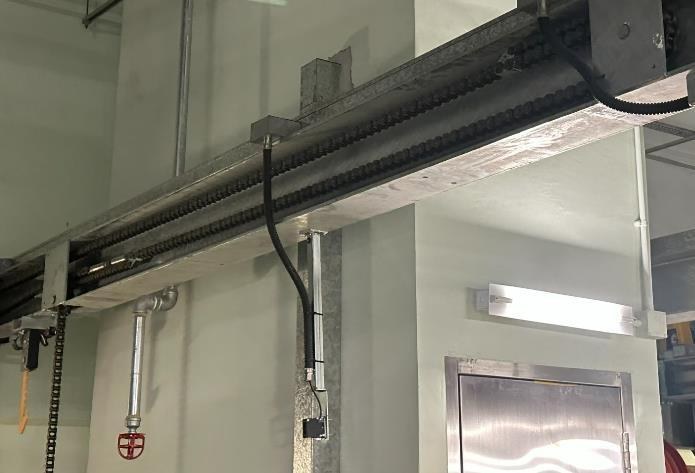
The overhead sensor moves with the platform, so vibration and mechanical movement must be included in the PLC diagnosis.
The problem: a restart restores service, not the root cause
The reported symptoms included:
- no response and no barrier movement after a card tap;
- repeated barrier movement after a valid command;
- the gate or platform stopping unexpectedly while in motion;
- the operator screen staying in an “operating” state until staff reset the system.
Faults did not occur every time, and a restart often restored service briefly. The affected control sections also behaved differently. That matters: a purely central software fault would normally affect every zone together. A concentration in selected sections points to control boxes, I/O, PLC logic, local networking or field installation.
What GNS did: turn a rare fault into readable evidence
1. Reconstruct the CAS-to-PLC control chain
The car-park management system (CAS) sends a command through an I/O controller to the Siemens S7 PLC, which controls the barrier, car platform and protection devices. GNS mapped:
- when CAS issued the control command;
- whether the I/O controller received and cleared the signal;
- which PLC state was entered;
- whether the field mechanism completed its movement;
- whether CAS received a real completion acknowledgement.
The purpose was to find the missing confirmation between “command sent” and “equipment completed”.
2. Record live PLC memory and timing
GNS developed a project-specific data logger that read key Siemens S7 PLC memory over Ethernet and recorded control pins, reset timing, alarms and operating states.
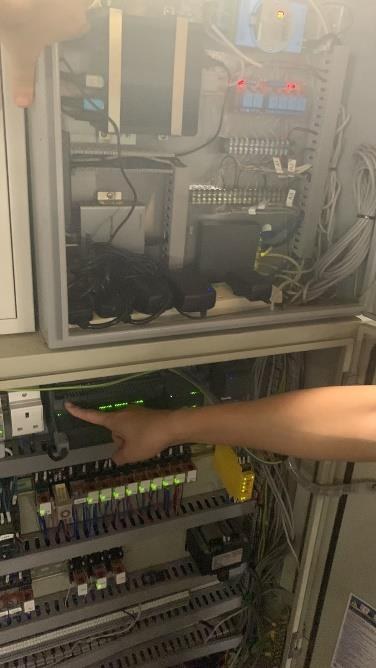
The enclosure contains PLC, I/O, IPC and networking equipment; a fault is not automatically a single hardware failure.
Testing showed that reset timing was not consistent. Some reset signals exceeded the PLC's expected window, while other tests did not clear the state as expected. That creates two opposite failure modes:
- the reset remains active too long and retriggers the PLC sequence;
- the reset is too short for the PLC to accept, leaving the sequence waiting while the application remains in an operating state.
This explains why replacing a barrier, restarting a PC or asking the driver to tap again may restore one cycle without removing the cause.
3. Trace I/O and control-box connection competition
The investigation also recorded connection errors between CAS and the I/O controller. The control enclosure contained multiple small network devices, and separate CAS programs used similar paths to acquire data from the same hardware family. Connection count, network condition and device restart timing could therefore create intermittent communication failures.
GNS proposed a controlled direct PLC Ethernet interface, consolidation of the control-box network, isolation from unrelated devices and a single data-access service that shares state with other applications. This prevents several programs from competing for the same controller connection.
4. Add sensors, mounts and machine vibration to the diagnosis
Another failure group occurred while equipment was moving. PLC protection logic monitored barrier, frontal, charging-cable, overhead and vehicle-presence sensors. A single unintended input could stop the cycle.
Field checks found:
- infrared emitter/receiver pairs misaligned over long installation distances;
- some long-range sensors performing below their nominal stable range;
- an overhead sensor whose position changed with movement and vibration of the platform;
- additional sensors mounted on moving equipment without adequate PLC filtering.
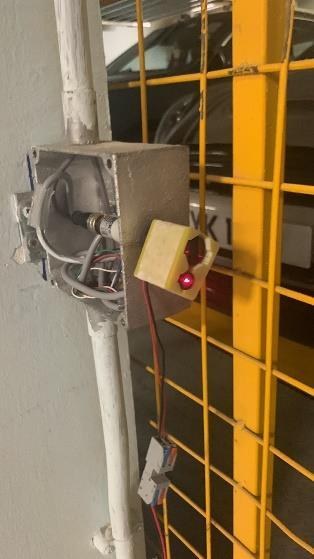
The calibration tool establishes a physical reference for the installed sensor position.
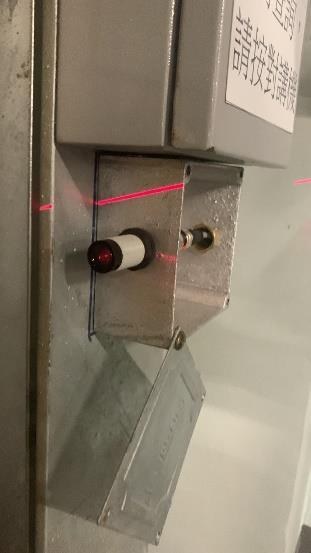
A small error over a long infrared path can make the receiver lose signal intermittently.
The root cause was a combination of conditions
| Area | Investigation finding | Operational effect |
|---|---|---|
| Control timing | PLC reset timing varied and sometimes exceeded the expected window | Retriggering, missed start, screen stuck in operation |
| CAS and I/O | Application state did not confirm physical completion | Staff believed the equipment was still running |
| Industrial network | Multiple devices and competing control connections | Intermittent disconnection and lost control messages |
| Sensors | Long-range misalignment and unstable signal | False safety input |
| Mechanical installation | Platform vibration changed sensor position | Repeated stops during movement |
| Exception handling | Limited timeout, retry and recovery logic | Manual restart required |
The fix therefore cannot be a single delay added to PLC code or a quick sensor re-position. Each layer needs measurement, change control and acceptance evidence.
Proposed remediation
Controlled PLC interface
Under approved safety and change procedures, use a controlled Ethernet interface to read PLC state and reduce dependence on the legacy I/O timing and unstable connection path. The interface handles acknowledgement, timeout, retry, failure reporting and operational records.
Industrial control network
Consolidate the small switches inside the control enclosure into an appropriate industrial switch, and separate PLC, CAS, I/O and general office traffic to reduce connection competition and external influence.
Sensor mounting and calibration
- create a more stable mount for the gate sensor;
- recalibrate every infrared emitter/receiver pair;
- add suitable timing tolerance for platform vibration;
- evaluate higher-power sensing or laser scanning over long distances;
- disable sensors that are unnecessary or unsuitable for the operating mode.
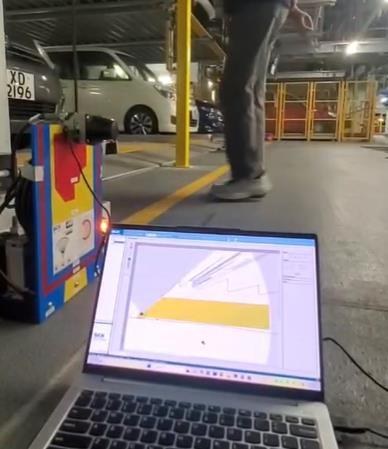
Laser scanning is tested where a long-range infrared pair is difficult to align and maintain.
Pilot before phased rollout
The improvement does not require closing the whole car park. GNS uses selected bays and control sections to verify timing, network, sensing and operating procedures before extending the work by risk.
What this case means for parking and IoT projects
A dashboard is not a physical state
A smart parking or IoT system extends across edge devices, PLC, gateway, network, broker, backend and application. “Online” does not prove that a command was executed. “Running” in the PLC does not prove that the physical mechanism completed its movement.
Time synchronisation and event order are evidence
When an incident involves multiple sensors, commands and operator actions, the events must be placed on one timeline. Otherwise each system may show “normal” simply because their records are not aligned.
Operational safety comes before a quick code change
PLC controls may interact with vehicle movement, fire systems, lifts, anti-crush protection and safety circuits. Every change needs version backup, impact assessment, controlled testing, rollback and operational approval. Protection must never be bypassed to shorten an investigation.
GNS services
GNS supports parking, building, industrial automation and IoT projects with:
- Siemens S7 PLC, SCADA, CAS, I/O and gateway diagnostics;
- PLC memory, control-pin, alarm and live-data logging;
- industrial networking, switches, VLANs, remote access and connection analysis;
- infrared, radar, laser scanner and long-range sensor testing;
- interface software, exception workflows, monitoring and API integration;
- installation, calibration, testing, acceptance and after-sales support.
If a parking or IoT system works after a restart and then fails again, start with PLC & IoT System Diagnostics or review the Hong Kong smart parking system solution.
Conclusion
The Hong Kong government office car-park case shows that an intermittent fault is not automatically a slow computer or a failed PLC. The answer often sits between control timing, application acknowledgement, industrial networking, mechanical vibration and field installation. Live data and field measurements must be brought into one evidence chain before a change can be defended, repeated and accepted.
This article is based on GNS's site investigation and technical consulting work. Location, sensitive system, network and customer details have been omitted. Final PLC, equipment and safety changes depend on the installed models, programs, operational approval and test results. Last updated: 12 November 2026.
FAQ
What was GNS's role in the government office car park project?
GNS acted as a technical consultant and system diagnostician, analysing the signal chain between the car-park management system, Siemens S7 PLC, I/O, control-box network and sensors. We identified intermittent fault mechanisms and proposed a revised PLC interface, industrial networking, exception handling, sensor mounts and calibration methods.
Why was the operator screen not enough to find the fault?
The screen reflects application state, not necessarily whether a command reached the PLC or whether the barrier, platform or conveyor completed its movement. GNS correlated CAS, I/O, PLC memory, control pins, alarms and field sensor behaviour to reconstruct the incident sequence.
How can PLC reset timing cause intermittent faults?
A pulse that is too short may not be accepted by the PLC. A pulse that lasts too long, or a reset that is not cleared in time, may retrigger the sequence. The design timing, actual PLC state and physical motion need to be tested together.
Why did sensors stop the equipment while it was moving?
Infrared pairs require accurate alignment. Long-distance drift, loose mounting, vibration on moving platforms, reflection and insufficient sensing range can all create false triggers. If protection logic depends on a single sensor input, the equipment may stop mid-cycle.
Did the whole car park need to be replaced?
No. GNS established evidence first, then proposed controlled changes to the PLC interface, industrial switch, exception logic, sensor mounting and calibration. Selected bays are used as a pilot before a phased rollout.
How long did the car park PLC investigation take?
The project representative confirmed that the intermittent issue, which had affected the team for about six months, was resolved within two weeks. GNS first correlated the signal timing across CAS, PLC, I/O and sensors, turning a difficult-to-reproduce fault into verifiable technical evidence before addressing the interface, network, sensors and exception logic.