Hong Kong Smart Parking System Integration Guide: ANPR, Bay Guidance, Payment, CCTV and IP Audio
GNS Engineering Team 8 min read
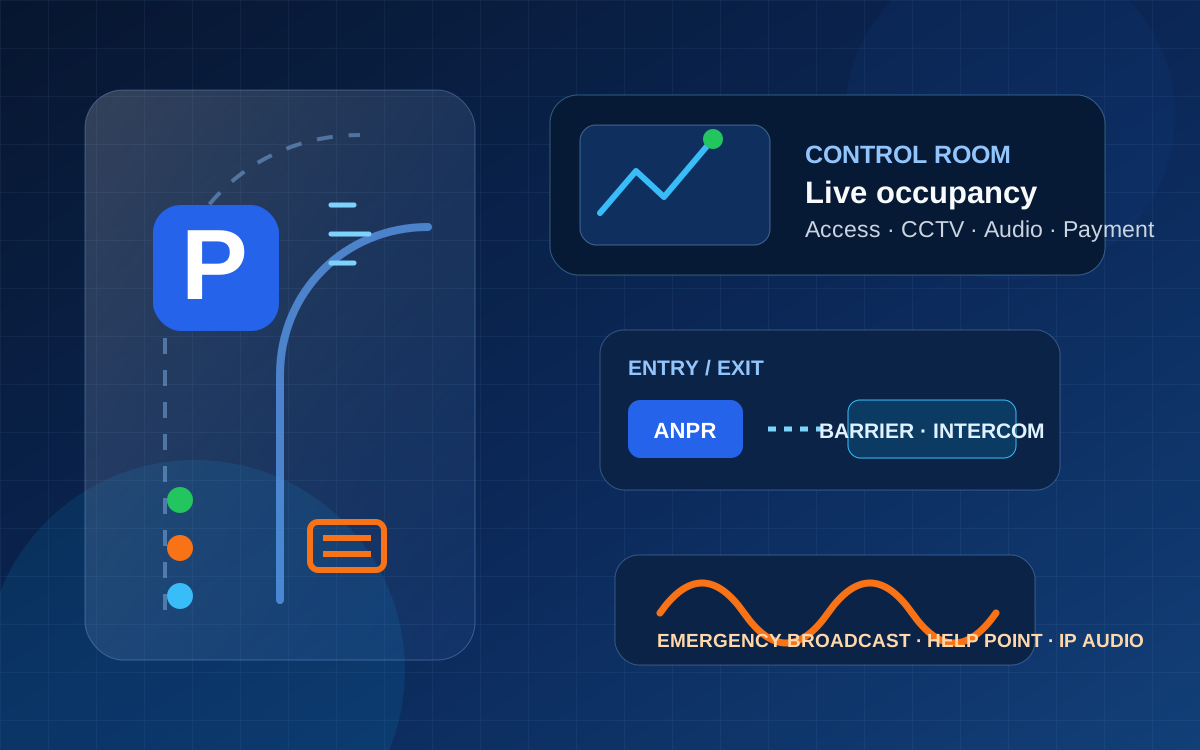
Parking looks like a simple four-step operation: enter, park, pay and leave. In reality, it depends on separate systems for ANPR, barriers, intercom, bay sensing, guidance lights, payment terminals, CCTV, control room, central management, networking and emergency broadcast. When each system is supplied by a different contractor, the main risk is rarely the hardware itself. It is inconsistent data, unclear responsibility at system boundaries, slow fault diagnosis and an architecture that cannot grow.
This guide explains how a Hong Kong smart parking system should be planned, integrated, installed and accepted. It also separates the full parking-system scope from the narrower role of ZYCOO IP Audio and the ZCAS/GNS audio solution.
Distinguish the whole system from a subsystem
There are two different propositions in the market:
- A complete smart parking system: ANPR, access control, barriers, bay sensors, guidance, payment, CCTV, control room, central platform and network.
- A parking IP Audio and intercom system: control-room communication, help points, emergency broadcast, find-my-car announcements, background music and evacuation messages.
They can work together, but should not be presented as the same product. If a site needs only audio and intercom, see the ZYCOO IP Audio parking and transport-hub solution. If it needs several subsystems with unified alarms and reporting, start with the Hong Kong smart parking system design and integration page.
Defining the boundary has three practical benefits: the quotation avoids duplicated interface charges; faults can be assigned to the right owner; and future bay sensing or payment upgrades do not require replacing the network and control room.
The eight core modules
1. Entry, exit and ANPR
ANPR identifies the vehicle before the barrier, access rule and occupancy controls decide whether to release it. Hong Kong car parks often have short ramps, steep approaches, glare and changing light. Camera angle, illumination, trigger position and vehicle speed therefore matter as much as the recognition software.
The design must also cover:
- day, night, rain and backlight conditions;
- Hong Kong plate formats and cross-border vehicles;
- manual handling when recognition fails;
- different rules for visitors, monthly users, staff, deliveries and emergency vehicles;
- offline release strategy when the network or central platform is unavailable.
2. Barriers and physical control
A barrier should not depend on a software command alone. The control box, loop detector, anti-crush protection, manual release, fire-alarm link and backup power are part of the delivery. A barrier bought without coordination between ANPR, intercom and the control room often produces situations where the software says “open” but the barrier remains down.
3. Bay sensing and guidance
Multi-storey car parks need live occupancy by zone. Common technologies include ultrasonic sensors, camera-based bay detection and magnetic sensing. Guidance can add bay lights, zone vacancy displays and find-my-car functions.
There is no universal best sensor. Ceiling height, lighting, bay layout, dust, maintenance access and budget all matter. The design must handle incorrect parking, sensor failure and vehicles passing over a bay without treating every reading as an occupancy event.
4. Payment and central operations
Payment may involve terminals, QR codes, Octopus, cards or an existing platform. The exact methods depend on supplier certification and the policies of the landlord, mall or operator.
The central platform should support:
- occupancy, revenue, entry/exit and exception events;
- monthly and visitor access;
- validation, free-parking and merchant redemption;
- reconciliation and fault reports;
- APIs to property management, CRM, ERP or other owner systems.
A platform that displays device status but cannot support revenue reconciliation and operational exceptions still creates manual work.
5. CCTV and the control room
CCTV is used for incident review, bay status, entry/exit events and live control-room response. Avoid connecting every camera to a recorder without network planning, and define image retention, time synchronisation, backups and access rights.
The control-room layout should follow operating procedures rather than filling every screen with camera feeds. Entry alarms, help points, payment exceptions and fire events need clear priority.
6. IP Audio, intercom and emergency broadcast
Parking audio is not just background music. Entry, exit, payment areas, driveways, lift lobbies, accessible bays, loading zones and management offices may need:
- two-way communication with the control room;
- emergency help buttons and visual indicators;
- announcements by level or zone;
- find-my-car and traffic messages;
- fire or evacuation instructions;
- background music and daily operations announcements.
ZYCOO IP Audio can operate as this layer on its own or integrate with ANPR, CCTV and the control room. A common design sends an event such as “barrier fault”, “vehicle stopped too long” or “help point activated” to the operator, who can then broadcast only to the relevant zone instead of the whole car park.
7. Network and system interfaces
The parking network should be separated from office systems, mall Wi-Fi and guest access. A practical baseline is:
| Network zone | Main use | Design focus |
|---|---|---|
| Parking operations | ANPR, barriers, sensors, payment | Fixed IP, VLAN, monitoring, offline resilience |
| Audio and video | CCTV, IP Audio, intercom | Bandwidth, power, audio/video synchronisation |
| Management | Control room, servers, cloud links | Least privilege, backup, audit logging |
| Public | Guest Wi-Fi, payment or information terminals | Isolation and rate limiting |
Use wireless only where it is appropriate. Barriers, access controllers and payment equipment should normally be wired. If wireless is unavoidable, address coverage, reconnection and device authentication.
8. Privacy, cybersecurity and operations
Plate data and video can identify people and therefore require careful handling. A baseline design includes:
- a defined purpose and privacy notice;
- retention periods and automated deletion;
- role-based access, MFA and audit logs;
- encryption in transit and at rest;
- default-password removal, firmware updates and patch management;
- CCTV time synchronisation, export records and image integrity;
- temporary access and work records for maintenance staff;
- incident response, backup and recovery exercises.
Government, public bodies and large property managers often require security policies, incident reporting, account inventories and acceptance documents. These controls cannot be postponed until after go-live.
A practical four-layer architecture
- Field devices: ANPR cameras, barriers, sensors, payment terminals, CCTV, intercom pillars and network speakers.
- Edge control: access controllers, audio servers, video recorders, network switches and backup power.
- Management platforms: parking management, payment, CCTV, IP Audio, reporting and APIs.
- Operations: control room, property management, security, maintenance and finance reconciliation.
Every layer needs a failure mode. If the central platform is unavailable, can the local controller still release vehicles? If the network fails, can an intercom call reach a local fallback? If power fails, are barriers, the control room and communications supported by UPS or a generator?
Upgrading an existing car park in phases
Many Hong Kong sites still operate analogue audio, standalone payment machines and isolated CCTV. Replacing everything at once is expensive and disrupts traffic. A safer sequence is:
Phase 1: Site audit and network clean-up
Record bay counts, entry/exit points, driveways, ceiling heights, plant rooms, power, existing cabling, network points, equipment brands and maintenance condition. Also measure daily traffic and peak periods. This identifies the real bottleneck instead of replacing equipment solely because it is old.
Phase 2: Stabilise the network and control room
Create an operations VLAN, naming convention, IP plan, time synchronisation, remote monitoring and basic backups. Updating barriers or cameras without this foundation produces limited benefit.
Phase 3: Replace by operational risk
Prioritise entry/exit, emergency broadcast, payment disputes or frequently failing equipment. Analogue audio can initially be connected through an IP gateway, keeping serviceable amplifiers and speakers before selected zones are replaced.
Phase 4: Add guidance, data and automation
Once the foundation is stable, add bay guidance, find-my-car, traffic analytics, validation and cross-system alarms. This avoids buying devices in Phase 1 that cannot exchange data with the future platform.
Selecting a parking-system integrator
Do not compare vendors on hardware brands or the lowest price alone. Check whether the supplier will:
- perform a site and process audit before proposing equipment;
- document responsibility at every subsystem boundary;
- integrate networking, CCTV, IP Audio, APIs and the control room;
- test offline operation, network loss, power loss and emergency vehicles;
- provide network diagrams, IP schedules, account inventories and operating documents;
- deliver local repair, spare parts, remote support and upgrade planning;
- understand government, public-body or large-property security and procurement requirements.
GNS can act as the overall systems integrator or deliver a defined subsystem. ZYCOO is used where the scope is parking audio, intercom and emergency broadcast. For a complete car park, GNS coordinates suitable ANPR, barrier, sensing, payment and CCTV platforms and remains responsible for network, installation, testing, acceptance and local support.
Acceptance must test failure, not only the happy path
Recommended tests include:
- monthly, visitor, staff and emergency vehicle entry/exit;
- failed recognition, obscured plates and duplicate entry;
- barrier power loss, communication loss and manual release;
- payment completed but no record received by the platform;
- live CCTV, playback, export and time accuracy;
- zoned announcements, background music, emergency audio and intercom;
- automatic reconnection after network loss;
- control-room alarm, handling and closure;
- backup, recovery and account permissions.
The handover should list equipment serial numbers, software versions, network points, accounts and warranty dates.
Summary
A smart parking system creates value by making entry, bays, payment, CCTV, audio and the control room work from consistent data and processes. Define the scope first, then design the network, privacy and failure handling, and only then select hardware.
For parking IP Audio, intercom and emergency broadcast, see ZYCOO's Hong Kong PA system solution. For full parking-system planning, review the Hong Kong smart parking solution or send GNS your site details so the scope can be phased around bay counts, access points, existing equipment and operating requirements.
If a live system shows no response after card taps, repeated barrier movement or mid-operation stops, read the government office car-park PLC fault investigation and PLC & IoT System Diagnostics.
FAQ
What does a Hong Kong smart parking system normally include?
Common elements include entry and exit ANPR, barriers and intercom, bay sensors, bay guidance, payment, CCTV, a control room, a central management platform, networking and IP Audio or emergency broadcast. The exact scope depends on the site, operating processes and security requirements.
Can an existing car park be upgraded in phases?
Yes. Start with a site audit and network foundation, then update access, bay sensing, payment, CCTV and audio in phases. GNS retains serviceable existing equipment and addresses operational or security bottlenecks before replacing the whole site.
Can ZYCOO deliver the entire parking system?
ZYCOO covers IP Audio, public address, intercom and emergency call points. ANPR, barriers, bay sensors, payment and CCTV are selected from suitable vendors for each project, with GNS responsible for overall integration, network design, testing and local support.
Why should car-park audio be zoned?
The entry, exit, payment area, driveways, levels, lift lobbies and control room have different operating needs. Zoning prevents unnecessary all-site announcements and lets evacuation, find-my-car, operations and background music remain independent.
How should ANPR and CCTV data meet privacy requirements?
The system should define collection scope, retention, access and deletion for a legitimate purpose, supported by network segmentation, audit logs, encrypted transport and operational records. Plate and video data should not be kept indefinitely or exposed to unauthorised users.
How is a smart parking system accepted?
Testing should cover normal and failure conditions, including offline operation, network loss, backup power, manual barrier release, ANPR failure, emergency broadcast, CCTV playback, payment reconciliation and control-room alarms. Network drawings, configuration records, account lists and operating documents should also be handed over.