Oracle GoldenGate Alternative Hong Kong: Deltaplex CDC Guide
GNS Engineering Team 12 min read
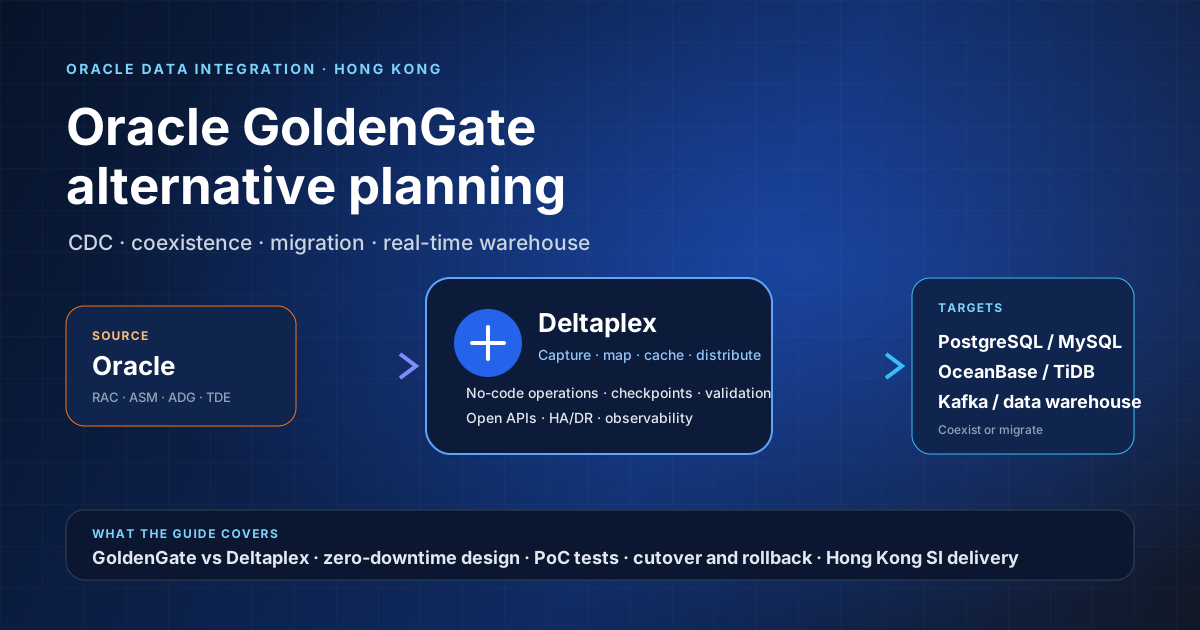
An Oracle GoldenGate alternative should not be selected from a feature list alone. The important question is narrower: which Oracle replication, CDC or integration functions does the organisation actually depend on, and can another platform deliver them with acceptable consistency, latency, operations and support risk?
GNS Technology Limited is a Hong Kong systems integrator and Deltaplex SI partner. This guide explains how to assess Deltaplex for Oracle GoldenGate-style replication, Oracle-to-PostgreSQL migration, Oracle CDC to Kafka and domestic-database projects. It also sets out the limits: Deltaplex is a real-time data integration platform, not a replacement for the Oracle Database engine.
A practical Oracle replacement assessment separates database-platform change from the CDC and integration layer.
Define the replacement boundary first
The phrase “Oracle alternative” appears in three different buying conversations:
- replacing Oracle Database as the application data platform;
- replacing Oracle GoldenGate or Oracle Data Integrator as the data movement and integration tool;
- reducing Oracle dependency by moving selected data or workloads elsewhere.
Deltaplex belongs mainly to categories two and three. It captures database changes, maps heterogeneous data, buffers it and delivers it to downstream systems. It does not execute Oracle SQL, replace Oracle application compatibility or remove the requirement to plan a database migration.
That distinction makes the assessment more useful. A bank may keep Oracle for its core application, while moving reporting or customer analytics to a real-time warehouse. A manufacturer may keep Oracle ERP, while synchronising selected tables to PostgreSQL or Kafka. A mainland or Hong Kong group may migrate one business domain to OceanBase, TiDB or a domestic database and use continuous replication during the transition.
When Oracle GoldenGate remains a valid choice
An alternative is not automatically better. Oracle GoldenGate can remain the correct option when:
- the environment is predominantly Oracle-to-Oracle;
- the team already operates GoldenGate well;
- existing licensing already covers the required use;
- Oracle-specific replication behaviour is a hard requirement;
- the support model and application certification depend on Oracle.
A fair evaluation should acknowledge those strengths. The project should focus on the real gap: licence economics, heterogeneous targets, no-code operations, domestic technology compatibility, central management, observability, support accountability or migration flexibility.
When to assess Deltaplex
Deltaplex is most relevant when one or more of these conditions apply:
- Oracle is one source among DB2, SQL Server, MySQL, PostgreSQL, OceanBase, TiDB, GaussDB, Kafka, files or APIs;
- one capture must feed a warehouse, a lake, Kafka and several applications;
- the organisation needs visual mapping and operations rather than code-heavy interface development;
- selected Oracle workloads are moving to PostgreSQL, MySQL or a domestic database;
- continuous synchronisation must support migration, disaster recovery or emergency cutover;
- Hong Kong engineering support must cover architecture, PoC, deployment, testing and after-sales responsibility.
The October 2026 Deltaplex overview lists proprietary Oracle capture options for standalone, RAC+ASM, ADG and CDB/PDB deployments with TDE, plus logical and physical capture paths for other databases. It also describes 70+ source and target types, distributed processing, checkpoints, error queues, data validation and no-code task management. These are vendor claims that must be verified against the exact versions and workloads in a PoC.
Five project scenarios most likely to create demand
1. Oracle to PostgreSQL or MySQL real-time synchronisation
Application modernisation often starts with a non-critical service, reporting database or regional system. The migration needs:
- a consistent initial load;
- Oracle redo/archive-log or another approved incremental capture method;
- schema, data type, LOB, precision and null handling;
- primary-key, unique-key and conflict rules;
- continuous replication during the parallel-run period;
- reconciliation and a rollback path.
A low-downtime migration is not created by CDC alone. The application must support a controlled cutover, connection change, cache handling, transaction draining and post-cutover validation. GNS treats Oracle-to-PostgreSQL migration as a combined database, integration, application and operations programme.
2. Oracle CDC to Kafka
Trading, risk, customer-behaviour and operational events are increasingly consumed as streams. A practical Oracle-to-Kafka design must define:
- which schemas and tables are in scope;
- topic and partition strategy;
- ordering and duplicate handling;
- schema registry or message contract;
- peak throughput and retention;
- checkpoint and replay behaviour;
- security, access control and monitoring.
The target is not just “data appears in Kafka”. The pipeline must remain explainable during schema changes, consumer outages, replay and partial failure.
3. Real-time data warehouse and Data Hub
Many organisations still move data through overnight batches. A real-time warehouse or Data Hub can ingest Oracle changes continuously, cleanse and map them, and distribute one captured record to finance, risk, customer analytics and operational dashboards.
This is where Deltaplex's capture–cache–consume–load model is relevant. GNS would size both the source capture and the slowest downstream target, because a fast capture engine cannot compensate for an overloaded warehouse or an unbounded Kafka topic.
4. Oracle to a domestic database
Programmes moving selected systems to OceanBase, TiDB, GaussDB, Dameng or GoldenDB need more than a source connector. They need evidence for:
- supported source and target versions;
- character sets, collation and data type conversion;
- DDL propagation and unsupported objects;
- transaction ordering and conflict policy;
- performance at realistic change volume;
- HA/DR, monitoring and cutover support.
The Deltaplex overview lists several domestic databases and support for domestic CPUs/OS. That makes a PoC worth considering, but the exact version matrix and compatibility still need vendor confirmation and project evidence.
5. Oracle DR, backup and emergency migration
Continuous replication can support real-time backup, a secondary site or emergency migration. The design must show what happens when:
- the source becomes unavailable;
- the capture agent stops;
- the network is interrupted;
- the cache or target is delayed;
- configuration changes occur;
- the primary site returns and failback is required.
Checkpoint recovery and task reassignment are useful only when operations teams know how to validate them and when to declare a controlled failover.
A practical reference architecture
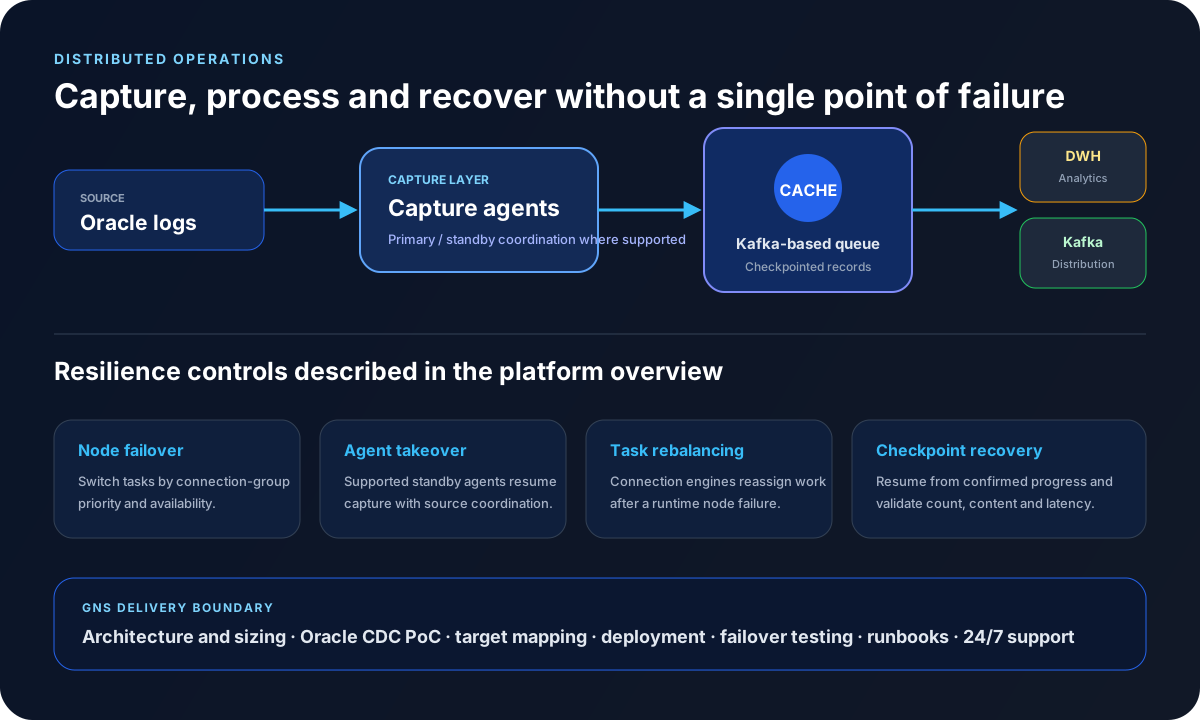
A distributed CDC design must include source access, capture, checkpointed cache, target loading, monitoring and recovery.
At a minimum, the architecture should define:
| Layer | Design question |
|---|---|
| Source | Oracle version, RAC/ADG/CDB/PDB, log mode, TDE, retention and access policy |
| Capture | Agent placement, privileges, restart behaviour and source impact |
| Internal processing | Schema mapping, filtering, cleansing, resource groups and error policy |
| Cache/queue | Retention, replay, ordering, isolation and capacity |
| Target | Write method, connection pool, conflict policy, latency and failure handling |
| Operations | Metrics, alerts, error queue, validation, runbooks and audit evidence |
| DR | Node failover, agent takeover, checkpoint recovery, RTO/RPO and failback |
The control plane and data plane should be designed together. A highly available capture node is not sufficient if the target has no retry policy or the operations team cannot identify which transaction failed.
How to run an Oracle GoldenGate replacement PoC
Phase 1: baseline the current function
Document the existing GoldenGate, Oracle Data Integrator, hand-built interface or ETL process. Capture source and target lists, table sizes, daily change volume, peak rate, DDL frequency, transformations, latency, retention, HA and support responsibility.
Phase 2: build representative test data
Use real schemas and data types wherever possible, with synthetic peak loads where required. Include:
- large and small tables;
- LOB and uncommon data types;
- deletes and key updates;
- DDL changes;
- schema and table filters;
- one-to-many and many-to-one mappings;
- intentionally failed records and reconnects.
Phase 3: measure the complete pipeline
Report initial-load time, sustained CDC rate, peak CDC rate, source CPU and I/O impact, end-to-end latency, target write time and recovery time. Do not compare a capture-only benchmark with an end-to-end GoldenGate workflow.
Phase 4: test failure, not only normal operation
Run controlled tests for:
- source or target disconnect;
- capture-agent restart;
- processing-node failure;
- cache backlog and replay;
- target rejection and error queue;
- application connection switching;
- failback to the original environment.
Phase 5: prove data and evidence
Use count validation, field-level checks, conditional checks and business reconciliation. The acceptance pack should include the architecture, versions, mappings, latency report, error handling, test evidence, runbook and rollback procedure.
Oracle-to-PostgreSQL cutover design
A low-downtime Oracle-to-PostgreSQL migration typically follows this sequence:
- freeze the target schema and conversion rules;
- load the Oracle baseline;
- start Oracle CDC and apply changes to PostgreSQL;
- run source-to-target reconciliation while the existing application remains live;
- complete application-level testing on the target;
- enter a controlled write-stop or reduced-write window;
- drain the final changes and verify the target;
- switch application connections;
- monitor, reconcile and keep the original Oracle path available for rollback.
The length of the write-stop window depends on the application, transaction design, cache, downstream dependencies and validation speed. A replication product should reduce the window; it cannot by itself ensure that an application can switch safely.
Oracle CDC to Kafka and warehouse design questions
For Kafka, define the message contract before implementation. For a warehouse, define the target merge and late-arrival policy. In both cases, use checkpoints and replay evidence.
| Question | Why it matters |
|---|---|
| Is a record ordered per primary key? | Required for some risk or trading use cases |
| Can duplicates occur? | Consumers need idempotent handling |
| How is schema evolution handled? | DDL can break downstream jobs |
| What is the maximum backlog? | Determines cache, storage and recovery time |
| Who owns replay and reconciliation? | Prevents operational gaps between teams |
| What is the latency at peak? | Average latency hides tail risk |
How much cheaper is Deltaplex than Oracle GoldenGate? Use a three-year TCO
Claims such as "30% or 50% cheaper" are not reliable without data volume, connectors, Oracle versions, HA, engineering scope and support. The October 2026 Deltaplex overview states that no-code configuration can reduce development and operations cost, but it does not promise a fixed discount. Put both options into the same three-year total cost of ownership (TCO).
| Cost area | Traditional GoldenGate-centric option | What to include for Deltaplex and GNS |
|---|---|---|
| Software and support | GoldenGate and related Oracle licences and annual support | Deltaplex licence, annual support and vendor responsibility |
| Connectors and interfaces | Every source, target, CDC or custom interface | Whether 70+ endpoint types actually reduce connectors and custom code |
| Infrastructure | Dedicated servers, HA, DR, cache and monitoring | Reuse of VM, container or Kubernetes capacity and HA nodes |
| Implementation | GoldenGate, Oracle and custom-development effort | GNS assessment, mapping, PoC, migration, testing and documentation |
| Operations | Multiple agents, scripts, dashboards, alerts and manual reconciliation | Visual tasks, central monitoring, error queues and automated recovery |
| Downtime and incidents | Cutover windows, parallel running, data replay and business disruption | Full load, CDC, validation, cutover, rollback and drills |
| Exit and parallel run | Legacy contract, specialist dependency and fallback environment | Transition period, knowledge transfer and exit arrangements |
The calculation is:
Three-year net saving = existing three-year TCO - Deltaplex three-year TCO - cutover, parallel-run and rollback costs
Saving percentage = three-year net saving / existing three-year TCO
Example: if the existing GoldenGate-centric three-year TCO is HK$1,000,000, the Deltaplex and GNS three-year TCO is HK$750,000 and HK$50,000 is reserved for cutover and parallel running, the net saving is HK$200,000, or 20%. This is a calculation example, not a fixed Deltaplex or GNS quotation.
The gap is often largest with many sources and targets, point-to-point interfaces, domestic databases, duplicated agents and scripts, and long-term operations. A single Oracle-to-Oracle replication with adequate existing licences and an experienced GoldenGate team may not justify a change on licence price alone.
For a TCO comparison, provide current Oracle and GoldenGate quotations and support, connector inventory, custom scripts, data volume, latency, HA/DR, annual incident and ETL effort, and cutover windows. GNS itemises licences, support, engineering, infrastructure, PoC, migration, parallel running and three-year operations. If there is no net saving or the risk outweighs the financial benefit, GNS does not recommend replacing the current platform.
What GNS delivers in Hong Kong
GNS can own the local programme from assessment to operations:
- Oracle and current-integration inventory;
- GoldenGate or ODI function comparison;
- Deltaplex architecture and sizing;
- Oracle, PostgreSQL, MySQL, Kafka, OceanBase, TiDB and domestic-database PoC;
- licence coordination and deployment;
- schema and data mapping;
- migration, cutover and rollback design;
- HA/DR, monitoring, validation and acceptance;
- knowledge transfer, local engineering support and optional 24/7 managed service.
For the partner page, architecture and cost comparison, see Deltaplex real-time data integration and Oracle GoldenGate alternatives in Hong Kong. Related GNS services include API integration, network infrastructure and 24/7 managed support.
Published vendor evidence
Deltaplex's October 2026 company and product overview describes banking deployments at China Minsheng Bank, Bank of Beijing, Jilin Bank, Bohai Bank, Shandong City Commercial Bank Alliance and Hebei Bank. Reported use cases include Oracle, DB2, MySQL, GBase, Kafka, Doris and domestic databases, with some projects listing second-level latency and tens of millions of daily changes.
Those are vendor-published references, not GNS Hong Kong delivery results, and the figures have not been independently benchmarked by GNS. Public vendor profiles are available on LinkedIn and YouTube.
Conclusion
The strongest Oracle GoldenGate alternative strategy is not “replace the logo”. It is to document the existing function, isolate the business and technical gap, build a representative PoC and prove data integrity, latency, recovery and operational ownership.
Deltaplex is worth evaluating where heterogeneous CDC, Oracle coexistence, Oracle-to-PostgreSQL migration, Oracle-to-Kafka, real-time warehousing or domestic-database replication are important. Oracle GoldenGate remains a valid choice for Oracle-centric estates where it already fits. GNS can help Hong Kong organisations make that decision with evidence rather than a feature-list comparison.
Oracle, Oracle GoldenGate and Oracle Database are trademarks of Oracle Corporation. Deltaplex technical details and references are based on its October 2026 company and product overview; final features, compatibility, licensing and support depend on current vendor documentation, the customer environment and PoC results. Last updated: 12 November 2026.
FAQ
What is the best way to evaluate an Oracle GoldenGate alternative?
Start with the functions you actually use, not the product name. Inventory sources, targets, Oracle versions, capture modes, DDL, data types, conflicts, latency, HA, monitoring and recovery. Then prove equivalent or improved behaviour with a controlled PoC.
Can Deltaplex replace the Oracle Database itself?
No. Deltaplex is a real-time data integration and CDC layer. It can help coexist with Oracle, offload data and migrate workloads, but it does not replace Oracle Database SQL execution, transaction processing, application compatibility or licensing.
Can Deltaplex support Database Migration?
Yes. It can provide the data movement and continuous-synchronisation core: full baseline load, log-based CDC, heterogeneous mapping, checkpoint recovery, retry handling, validation and parallel running. With GNS assessment, PoC, cutover, rollback and acceptance, it can support low-downtime or controlled-downtime migration. It does not replace the database engine; PL/SQL, application changes, database tuning, business UAT and licensing remain separate work, and no tool should promise zero downtime without a complete cutover design and rehearsal.
Can Oracle data be migrated to PostgreSQL without downtime?
A low-downtime design can reduce the cutover window, but zero downtime cannot be promised by the replication tool alone. The full baseline, incremental CDC, validation, application cutover, connection switching and rollback must all be engineered and exercised.
Does Deltaplex support Oracle RAC, ADG and TDE?
The October 2026 vendor overview lists standalone, RAC+ASM, ADG, CDB/PDB and TDE capture options. The installed Oracle version, log mode, security configuration and support matrix must be confirmed during assessment.
Can Oracle changes be sent to Kafka or a real-time warehouse?
Yes, this can be designed as a logical CDC pipeline. GNS would validate topics, partitions, ordering, schema mapping, duplicate handling, downstream checkpoints and peak throughput before production.
What should a Hong Kong Oracle CDC PoC measure?
Measure initial load, sustained and peak CDC rate, source impact, end-to-end latency, DDL propagation, error recovery, reconnect, node failover, target validation and rollback. The PoC should use representative data and failure cases.
How much cheaper is Deltaplex than Oracle GoldenGate?
There is no reliable fixed discount. Compare the existing GoldenGate-centric licence, annual support, connectors, infrastructure, implementation, parallel run, operations and cutover costs with the Deltaplex and GNS three-year total cost of ownership. GNS calculates the net saving and percentage from the customer's actual quotations and recommends keeping the current platform if the saving, function or risk profile does not justify a change.