SICK TiM310 in Hong Kong: 2D LiDAR Selection, Applications and Procurement Guide
GNS Engineering Team 8 min read
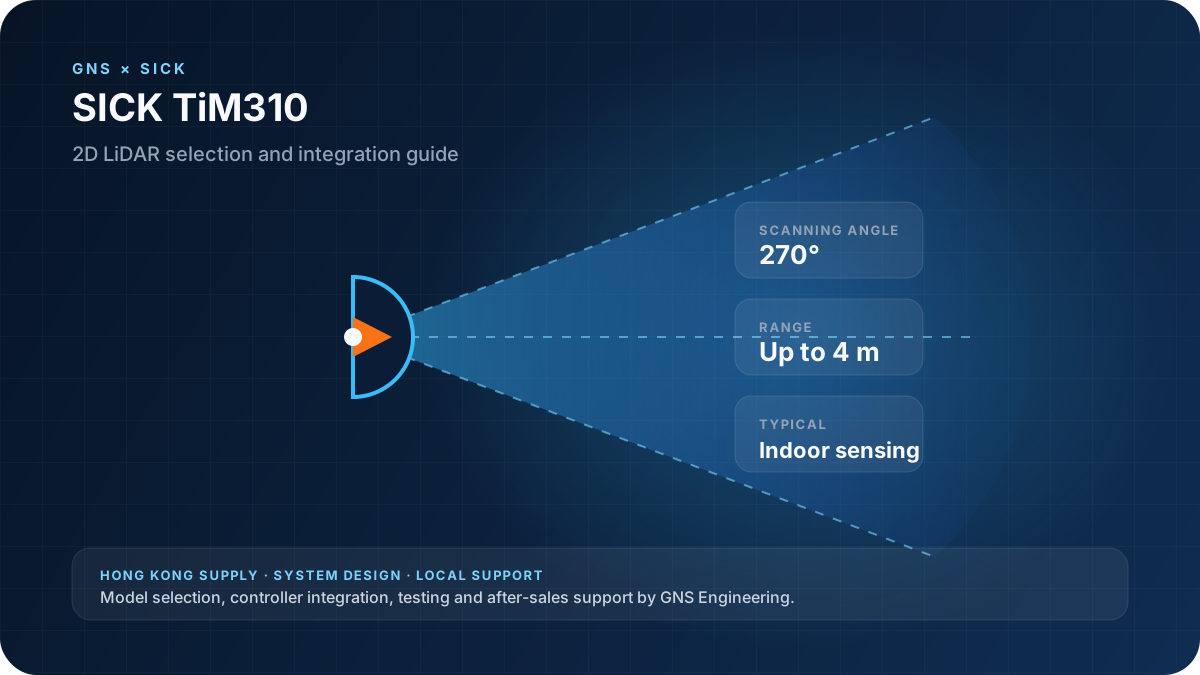
The SICK TiM310 is a compact 2D LiDAR laser scanner. It continuously measures the distance from the sensor to objects or surfaces along a single scanning plane. Typical uses include indoor area monitoring, object-presence detection, distance measurement and logistics equipment. For Hong Kong systems integrators, machine builders and end users, the key purchase question is not simply whether stock is available. It is whether the effective sensing range, object reflectivity, mounting position, controller logic, environmental interference and acceptance method suit the application.
This guide explains the practical role of the TiM310 in Hong Kong industrial and logistics projects. GNS is SICK's systems integration (SI) partner and reseller in Hong Kong, providing genuine products, model selection, installation, testing and after-sales support.
Where the TiM310 fits
The TiM310 belongs to SICK's TiM family of 2D LiDAR sensors. It scans a plane and outputs distance data, which a controller or software can turn into area, object or position decisions. Compared with a single-point photoelectric sensor, 2D LiDAR covers a wider fan-shaped area and can show the direction in which an object appears.
Common applications include:
- area monitoring at vehicle tail lifts, loading bays and logistics gates;
- object-presence detection on conveyors, packaging machines and automation equipment;
- obstacle detection for mobile equipment or indoor vehicles;
- distance measurement around industrial machinery;
- indoor scanning for buildings, facilities and research projects.
The TiM310 is not intended to replace every sensor. Its value is a programmable 2D sensing layer that covers a useful area and integrates with a control system.
Typical specifications and selection points
| Item | Typical information | What it means for the project |
|---|---|---|
| Scanning angle | 270° | Covers a broad area ahead and to the sides, but the sensor rear and mounting structures still create blind zones |
| Maximum scanning range | Up to 4 m | This is an upper limit under suitable conditions, not a guaranteed detection distance for every object |
| Typical range | Around 2 m at 10% remission | Dark or low-reflectivity objects reduce effective distance; test with the real material |
| Measurement method | 2D laser scanning | Produces distance and area data within one plane; one scanner is not a complete 3D protective system |
| Operating environment | Indoor mobile or stationary applications | Mounting angle, vibration, contamination, ambient light and glass reflection all affect performance |
The official data sheet lists the interface, supply, environmental rating and output format for each model. TiM310 variants exist, so a quotation should be based on the full model code and current data sheet, not the family name alone.
TiM310 versus a safety laser scanner
This is the most important distinction in procurement.
The TiM310 is primarily a distance-measurement and area-monitoring sensor. It can detect whether a person or object is present and send the result to a controller, PLC, warning device or another system. A general-purpose sensor is not, by itself, proof that a machine risk assessment is complete or that a specified PL/SIL safety function is available.
For machine guarding, hazardous-area interlocks or projects governed by standards such as EN ISO 13849-1, IEC 61508 or EN 62061, the risk assessment must determine the required safety performance. The project then needs an appropriately certified safety laser scanner, safety controller, output architecture and validation process. SICK safety models such as nanoScan3 and microScan3 are selected according to the protective field, response time and required PL/SIL level.
A practical architecture can give each device a different role:
- The TiM310 provides general area status, object profile or process triggering.
- A certified safety laser scanner provides the functional-safety protection defined by the risk assessment.
- A safety controller handles interlocks and stop outputs.
- Audible/visual warnings and the management platform provide operator feedback and event records.
This avoids presenting a general-purpose sensor as a safety device while still matching cost, function and compliance requirements.
Application example: vehicle tail lifts and loading zones
During tail-lift operation, people may enter the danger area behind or beside the platform. GNS has designed tail-lift safety systems using SICK TiM310 2D LiDAR and related sensing technology:
- monitor the tail-lift operating area with 2D LiDAR;
- use a controller to determine whether a person or object has entered a defined field;
- provide audible and visual warnings to the driver and loading staff;
- inhibit lifting or trigger a stop through interlock logic where required;
- perform functional testing for the vehicle, lift size and operating procedure.
Where a specified PL/SIL functional-safety level is required, the system adds appropriately certified scanners and controllers. GNS then checks the certificate scope, response time, mounting distance and acceptance requirements. In this architecture, the TiM310 can provide general or supplementary detection but should not be treated as the sole safety device.
The tail-lift case can be anonymised at the customer's request. More demonstrations are available from EPE (Everpeak Engineering).
Application example: logistics and industrial automation
At logistics gates, conveyors, packaging lines and mobile equipment, the TiM310 can determine whether an object has arrived, an area is clear or an obstacle is present. The system design still needs to answer:
- how object colour, material and reflectivity change the effective range;
- whether guard rails, conveyor edges or brackets obstruct the scanning plane;
- whether dust, moisture, oil or vibration cause false triggers;
- how the controller distinguishes a brief pass, a stop and a genuine blockage;
- what the equipment should do if the controller or network fails;
- whether time, distance, alarms and operator actions must be recorded.
Comparing sensor prices alone cannot answer these questions. The result depends on integrating the sensor, mounting, controller and operating procedure as one design.
System integration architecture
A complete TiM310 application usually has five layers:
| Layer | Main equipment | Design focus |
|---|---|---|
| Sensing | TiM310 2D LiDAR | Scanning plane, angle, range, blind zones and interference |
| Control | PLC, industrial controller or edge device | Field evaluation, delay, filtering, interlocks and fault handling |
| Actuation | Relay, safety controller, stop or warning output | Output logic, failure modes and recovery |
| Local indication | Audible/visual alarm, beacon, buzzer | Clear status for drivers, operators and pedestrians |
| Records | HMI, SCADA, database or maintenance platform | Event time, alarms, testing and maintenance history |
If the data will later connect to GNS CARE or a customer platform, define the protocol, data format, access rights and retention period at design stage. Retrofitting integration later usually means changing the controller and network.
Installation and acceptance: a reaction is not enough
Mounting angle and scanning plane directly affect detection. Acceptance should not consist only of placing one object in front of the sensor and watching an indicator turn on. Tests should include:
- objects of different reflectivity, colour and size;
- targets entering from the left, right, centre and diagonal;
- people walking past, remaining in the field and entering unexpectedly;
- partial obstruction and contamination of the scanner;
- changes in ambient light, glass reflection and other laser sources;
- controller restart, communication loss and power recovery;
- warning, stop, recovery and manual reset procedures;
- complete handover of settings, drawings, model codes and test results.
Functional-safety applications also require validation against the risk assessment and applicable standards. Ordinary functional testing is not a substitute.
Why source and integrate the TiM310 through GNS
GNS combines product supply with engineering delivery:
- Genuine German import with formal quotation, invoice, serial-number and batch traceability;
- Model verification against the application, distance, environment and interface;
- Local technical support for mounting, wiring, controller logic and fault-finding;
- Functional testing, available in Hong Kong for selected applications;
- After-sales support for manufacturer repair, RMA, spare parts and alternative recommendations;
- Field experience from engineers with more than ten years of SICK product experience;
- Documented delivery, including drawings, settings, test results and acceptance records where required.
Informal online purchases make it harder to confirm source, warranty responsibility and technical support. Freight, clearance, taxes, testing and downtime can also remove any apparent saving.
Information to prepare before requesting a quotation
Send GNS the following information for accurate selection and pricing:
- Application and equipment type;
- Target object, size, colour and material;
- Maximum and typical detection distance;
- Mounting position, scanning plane and available space;
- Indoor/outdoor conditions, dust, moisture, vibration and temperature;
- Controller, PLC or computer input interface;
- Whether interlocks, stops, audible/visual warnings and data records are required;
- Whether PL/SIL or another functional-safety requirement applies;
- Quantity, delivery date, testing and acceptance documentation.
The more complete the information, the lower the risk of choosing the wrong variant or underestimating integration work.
Summary
The SICK TiM310 is a compact 2D LiDAR suited to indoor distance measurement and area monitoring, including tail-lift, logistics, conveyor and industrial-automation applications. It is not a universal sensor for every situation, and it cannot replace a safety device selected through a proper risk assessment.
Start with the application and risk requirement, then validate the model, scanning angle, effective range, environment, controller and acceptance method. GNS provides genuine Hong Kong supply, selection, installation, testing and after-sales support. See the SICK Hong Kong solution page or email gns@gnstec.com.hk.
Reference: SICK TiM310 official data sheet.
FAQ
What is the SICK TiM310?
The SICK TiM310 is a compact 2D LiDAR laser scanner that measures distance and detects objects within a scanning plane. It is used for indoor distance measurement, area monitoring, logistics and industrial automation. The exact interface, range and functions depend on the model and data sheet.
Is the SICK TiM310 the same as a safety laser scanner?
No. The TiM310 is primarily a distance-measurement and area-monitoring sensor. If an application requires a PL rating under EN ISO 13849-1 or a SIL rating under IEC 61508/EN 62061, a risk assessment must first determine the requirement and an appropriately certified safety laser scanner must be selected. A TiM310 can provide general or supplementary detection but cannot act alone as a functional-safety protective device.
What are the TiM310 scanning angle and range?
TiM310 models commonly provide a 270° scanning angle and a maximum scanning range of up to 4 m. SICK's data sheet also lists a typical range of 2 m for objects with up to 10% remission. Actual performance depends on object reflectivity, contamination, ambient light and mounting angle.
Can the TiM310 be used in a tail-lift safety system?
It can provide general detection or supplementary sensing for the tail-lift danger zone, working with a controller, audible/visual warning and interlock logic. If the system must meet a specified PL/SIL functional-safety requirement, the risk assessment must govern the choice of certified safety scanners, safety controller, validation and documentation.
Can GNS supply and test the TiM310 in Hong Kong?
Yes. GNS supplies genuine German-import SICK products with formal quotations, model selection and local technical support. Local functional testing can be arranged for selected applications. The engineering scope can cover mounting, power, I/O, controller logic, warnings, testing and acceptance records.
Why buy the TiM310 through GNS rather than an online seller in mainland China?
GNS provides traceable stock, formal quotations and invoices, manufacturer-warranty handling, Hong Kong technical support and project documentation. Local functional testing can be arranged for selected applications. With an informal online purchase, source, warranty, delivery and technical responsibility are harder to confirm, and freight, clearance, taxes and downtime may remove the apparent saving.